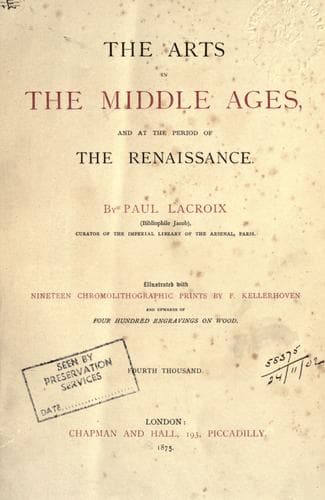
The Arts in the Middle Ages and at the Period of the RenaissanceJacob, P. L.
History
The Arts in the Middle Ages and at the Period of the Renaissance
Jacob, P. L.
Art, Medieval; Art, Renaissance; Middle Ages
elegance and grace with the châteaux of Nantouillet, Chenonceaux, and
Azai-le-Rideau; and with the manor-house of Ango, near Dieppe, all
sumptuous, lordly mansions; the old Louvre, the palace of kings, the
cradle of monarchy, was regenerated under the care of Peter Lescot; the
Hôtel de Ville, Paris, still bears witness to the varied talent of
Dominique Cortona, who, as M. Vaudoyer said of him, “justly understood
that, in building for France, he should act in a perfectly different
manner to that in which he would have acted in Italy.” Under Henry II.
and Charles IX. this activity continued, and the architects who sought
their inspirations in Grecian and Roman antiquity, as much as in the
_souvenirs_ of the Italian Renaissance, delighted in loading all the
elegant and graceful buildings with ornaments, with bas-reliefs, and
with statues, which they seemed to carve in the stone, as delicately
wrought as a piece of goldsmith’s work. Philibert Delorme built for
Diana of Poitiers the Château d’Anet, that architectural jewel whose
portico, transported piece by piece at the time of the revolutionary
disorders, now decorates the court of the Ecole des Beaux-Arts; Jean
Bullant built Ecouen for the Constable Anne de Montmorency; and the
architect d’Anet undertook, by order of Catherine de Medicis, the
construction of the Palace of the Tuileries, which, by a sort of
exigency resulting from its particular destination, seemed typically to
characterise the style of the French Renaissance.
[Illustration: Fig. 327.--Porte de Hal, Brussels. (Fourteenth Century.)]
We must not burden with details this summary of one of the most
important branches of art. The history of architecture is among those
vast domains which demand either a short epitome or a thoroughly deep
investigation. The epitome being alone consistent with the plan of our
work, we must confine ourselves to its limits; but we may, perhaps, be
allowed to think that the few rapid pages thus devoted to the subject
have inspired the reader with the desire of penetrating farther into a
study which is capable of offering him so many agreeable surprises, so
many rational delights.
[Illustration]
PARCHMENT AND PAPER.
Parchment in Ancient Times.--Papyrus.--Preparation of Parchment and
Vellum in the Middle Ages.--Sale of Parchment at the Fair of
Lendit.--Privilege of the University of Paris on the Sale and
Purchase of Parchment.--Different Applications of
Parchment.--Cotton Paper imported from China.--Order of the Emperor
Frederick II. concerning Paper.--The Employment of Linen Paper
dating from the Twelfth Century.--Ancient Water-Marks on
Paper.--Paper Manufactories in France and other parts of Europe.
Public-domain text, read in full here on John Shaqi.
Reviews
Reviews
No reviews yet
Be the first to share your thoughts on this work.
Elsewhere in the archive
Join the Discussion
Join the discussion
Sign in to leave a comment or review.
Sign InorCreate an account