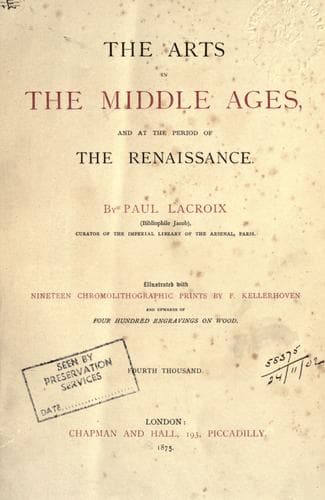
The Arts in the Middle Ages and at the Period of the RenaissanceJacob, P. L.
History
The Arts in the Middle Ages and at the Period of the Renaissance
Jacob, P. L.
Art, Medieval; Art, Renaissance; Middle Ages
Although most authors who speak of parchment attribute the invention of
it, on the testimony of Pliny, to Eumenius, king of Pergamus
(doubtlessly from the etymology of the word by which it was designated,
viz., _Pergamena_), it seems to be proved, according to Peignot, that
the use of it is much more ancient, and that its origin is utterly lost.
Certainly, in many passages of the Old Testament we find a Hebrew Word,
in Latin _volumen_, which can only be understood to mean a roll formed
of prepared skin or of the leaves of papyrus, and it is consequently
evident that the Jews, from the time of Moses, wrote the tables of the
Law on rolls of parchment.
Herodotus says that the Ionians called books _diphthera_ (διφθἑρα, a
prepared hide), because, at a time when the _biblos_ (βἱβλος, the inner
bark of the papyrus) was scarce, they wrote on skins of goats or of
sheep. Diodorus Siculus affirms that the ancient Persians wrote their
annals on skins, and we must suppose that Pliny’s assertion refers only
to some improvements the King of Pergamus had made in the art of
preparing a material that could supply the place of papyrus, which
Ptolemy Epiphanius would no longer allow to leave Egypt. The absolute
deficiency of papyrus raised into activity the fabrication of parchment,
and soon so large a quantity was seen to flow into Pergamus that this
town was considered as the cradle of the new trade, already so
flourishing. There were then books of two kinds, the one in rolls
composed of many leaves sewed together, on one side of which only was
there writing; the others, square-shaped, were written upon both sides.
The grammarian Crates, ambassador of Eumenius at Rome, passed as the
inventor of vellum.
Ordinary parchment is the skin of a goat, sheep, or lamb, prepared in
lime, dressed, scraped, and rendered smooth by pumice-stone. Its
principal qualities are whiteness, thinness, and stiffness; but the work
of the currier must have been formerly very imperfect, for Hildebert,
Archbishop of Tours in the eleventh century, tells us that the writer,
before beginning his occupation, “was in the habit of clearing away from
the parchment, with the aid of a razor, the remains of fat and other
gross impurities, and then with pumice-stone to make the hair and
tendons disappear:” this almost amounts to affirming that the scribes
bought the hide undressed, and, by an elaborate preparation, made them
fit for proper use. Virgin parchment, which in its grain and colour
resembles vellum, was made of the skins of those lambs and goats which
had been clipped. Vellum, more polished, whiter, more transparent, is
made, as its name indicates, of the hide of the calf.[52]
Public-domain text, read in full here on John Shaqi.
Reviews
Reviews
No reviews yet
Be the first to share your thoughts on this work.
Elsewhere in the archive
Join the Discussion
Join the discussion
Sign in to leave a comment or review.
Sign InorCreate an account