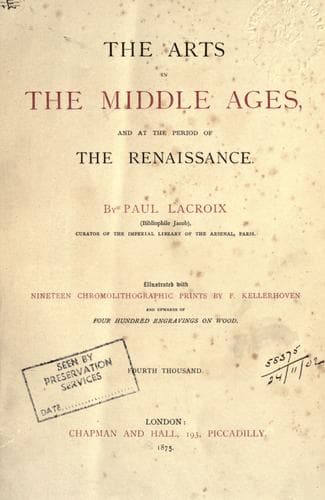
The Arts in the Middle Ages and at the Period of the RenaissanceJacob, P. L.
History
The Arts in the Middle Ages and at the Period of the Renaissance
Jacob, P. L.
Art, Medieval; Art, Renaissance; Middle Ages
The dimensions or sizes of our books at the present day have their
origin in the sizes of the parchment in olden times. The entire skin of
the animal, cut square and folded in two, represented the “in-folio,”
which, moreover, varied in length and breadth; and we have every reason
to suppose that paper, from the day it was invented, followed the
ordinary sizes of the folded parchment.
As to the dimensions of the parchment employed for diplomas, they varied
according to the time, the brevity of the matter, or the nature of its
employment. Among the ancients, who wrote only on one side of the
parchment, the skins were cut in bands joined together so as to form
_volumes_ or rolls, which were unrolled as their contents were read.
This custom was preserved for public and judicial acts for a long time
after the invention of the square book (_codex_) had caused the
_opisthographic_ writing to be adopted, by which is to be understood
writing on both sides of the page. In principle, only the final formulæ,
or the signatures, were written on the back of the document. By degrees
people adopted the practice of writing on the back as well as the front
of the page; but it was not till the sixteenth century that this custom
became general.
[Illustration: Fig. 331.--Seal of the King of La Basoche. (This title
was suppressed, with all its prerogatives, by Henry III.)]
Judicial acts, composed sometimes of many skins sewed together, came in
time to form rolls of twenty feet in length; to such extreme proportions
did they reach, though at first they were so small in size that their
limited dimensions are truly incredible; for in 1233 and 1252 we find
contracts of sales of two inches long by five inches wide, and in 1258 a
will written on a piece of parchment of two inches by three and a half.
It was by way of compensating for the great cost of parchment that
opisthographic writing was adopted and rolls were put aside; and the
name alone remains as applied to the _rolls_ of procedure. The size that
leaves should assume was also fixed, according to the different uses for
which they were intended. For instance, the leaves of parliamentary
documents were nine inches and a half long by seven and a half wide;
those of the council, ten by eight; those of finance and of private
contracts, twelve and a half by nine and a half; letters of pardon,
under the king’s hand, were to be on entire skins squared, two feet two
inches by one foot eight inches in diameter.
[Illustration: Fig. 332.--The Paper-Maker, drawn and engraved in the
Sixteenth Century by J. Amman.]
Public-domain text, read in full here on John Shaqi.
Reviews
Reviews
No reviews yet
Be the first to share your thoughts on this work.
Elsewhere in the archive
Join the Discussion
Join the discussion
Sign in to leave a comment or review.
Sign InorCreate an account