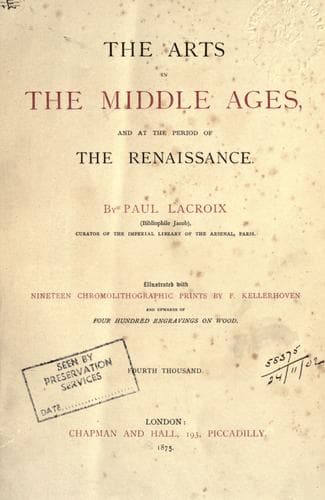
The Arts in the Middle Ages and at the Period of the RenaissanceJacob, P. L.
History
The Arts in the Middle Ages and at the Period of the Renaissance
Jacob, P. L.
Art, Medieval; Art, Renaissance; Middle Ages
virgin parchment, which from its nature was suited to the delicacies of
calligraphy and illumination. Moreover, we see from a statute of the
University of Paris, dated 1291, that the parchment trade had attained
at that period to considerable development; so, as a protection against
the frauds and deceptions which might result from the great competition
of traders in it, and to insure a good article being furnished to
students and artists, a special privilege was granted to the university,
which, in the person of its rector, had not only the right of
inspection, but also the refusal of all parchment bought in Paris, no
matter whence it had come. Besides which, at the fair of Lendit, which
was held every year at Saint-Denis, on the domains of the abbey (Fig.
329), and at the fair of Saint-Lazare, the rector likewise caused the
parchment brought to them to be examined, and the merchants of Paris
could not purchase any till the king’s agents, those of the Bishop of
Paris, and the masters and scholars of the university, had provided
themselves with what they required (Fig. 330). Let us add that the
rector was paid a duty on all parchment sold, and the result of this
tax was the only source of income attached to the rectorship in the
seventeenth century.
Although white parchment seems to be the best suited for writing, the
Middle Ages, following the example of antiquity, gave to the material
various tints, especially purple and yellow. The purple was chiefly
intended to receive characters of gold or silver. The Emperor
Maximinius, the younger, inherited from his mother the works of Homer
inscribed in gold on purple vellum; and parchment tinted in this way
was, during the first centuries, one of the prerogatives reserved for
princes and the great dignitaries of the Church. It is remarkable that
the barbarism of the seventh and eighth centuries did not diminish the
favour in which these luxurious manuscripts were held. Little by little,
however, the custom (of writing the entire work in gold or colours)
dwindled away. Scribes began by colouring a few pages only in each
volume, then some margins or frontispieces; and lastly this decoration
was restricted to the heads of chapters, or to words to which great
prominence was to be given, or to capital letters. The _rubricatores_
(literally, writers in red), workmen who performed this operation, came
in time to be mere painters of letters or _rubrics_ (so called because
they were originally painted red), of whose assistance, however, the
first printers availed themselves to _rubric_ or colour the initials of
missals, Bibles, and law books.
Public-domain text, read in full here on John Shaqi.
Reviews
Reviews
No reviews yet
Be the first to share your thoughts on this work.
Elsewhere in the archive
Join the Discussion
Join the discussion
Sign in to leave a comment or review.
Sign InorCreate an account