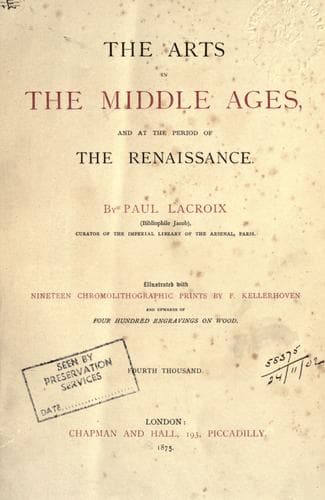
The Arts in the Middle Ages and at the Period of the RenaissanceJacob, P. L.
History
The Arts in the Middle Ages and at the Period of the Renaissance
Jacob, P. L.
Art, Medieval; Art, Renaissance; Middle Ages
At any rate, the most ancient writing on paper made of rags known at the
present day is a letter from Joinville to Louis X., dated 1315; we may,
moreover, mention with certainty, as written on linen paper, an
inventory of goods belonging to a certain Prior Henry, who died in 1340,
which is preserved at Canterbury, and many authentic writings, dating
back as far as 1335, preserved in the British Museum, London. The first
paper-manufactory established in England was, it is said, at Hertford,
which dates only from 1588; but important paper-manufactories existed in
France from the reign of Philippe de Valois, that is, from the middle of
the fourteenth century; particularly at Essonne and at Troyes. The paper
which came from these manufactories bore generally, in the paper itself,
different marks (Fig. 333) called water-marks, such as a bull’s head, a
cross, a serpent, a star, a crown, &c., according to the quality or
destination of the paper. Many other countries in Europe had also
flourishing paper-manufactories in the fourteenth century. From this
period we find, indeed, a large number of documents written on paper
made of rags, the use of which thus preceded by about a century the
invention of printing.
[Illustration: Fig. 334.--Banner of the Paper-Makers of Paris.]
MANUSCRIPTS
Manuscripts in Olden Times.--Their Form.--Materials of which they
were composed.--Their Destruction by the Goths.--Rare at the
Beginning of the Middle Ages.--The Catholic Church preserved and
multiplied them.--Copyists.--Transcription of
Diplomas.--Corporation of Scribes and
Booksellers.--Palæography.--Greek Writings.--Uncial and Cursive
Manuscripts.--Sclavonic Writings.--Latin Writers.--Tironian
Shorthand.--Lombardic
Characters.--Diplomatic.--Capetian.--Ludovicinian.--Gothic.--Runic.--
Visigothic.--Anglo-Saxon.--Irish.
Let the reader refer to the chapters on PARCHMENT and BINDING, and he
will find a few remarks on the purely material part of manuscripts; we
may, then, here treat this question very summarily; and for that purpose
we shall avail ourselves of the remarkable work of J. J.
Champollion-Figeac.
When writing was once invented, and had passed into general use in
civilised society, the choice of substances suited for its reception,
and to fix it in a durable manner, was very diversified, although
depending on the nature of the text to be written.
Public-domain text, read in full here on John Shaqi.
Reviews
Reviews
No reviews yet
Be the first to share your thoughts on this work.
Elsewhere in the archive
Join the Discussion
Join the discussion
Sign in to leave a comment or review.
Sign InorCreate an account