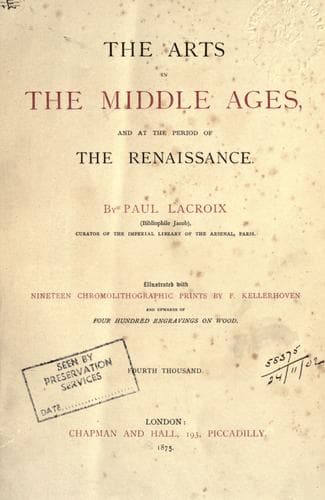
The Arts in the Middle Ages and at the Period of the RenaissanceJacob, P. L.
History
The Arts in the Middle Ages and at the Period of the Renaissance
Jacob, P. L.
Art, Medieval; Art, Renaissance; Middle Ages
People wrote on stone, on metals, on the bark and leaves of many kinds
of trees, on dried or baked clay, on wood, on ivory, wax, linen, the
hides of quadrupeds, on parchment, the best of these preparations; on
papyrus, which is the inner bark of a reed growing in the Nile; then on
paper made of cotton; and lastly, on paper made from hemp and flax,
called rag paper. The Roman world had adopted the use of papyrus, which
was a very important branch of commerce at Alexandria. We find proof of
this in the writers of antiquity: St. Jerome bears witness to it as far
as regards the fifth century of our era. The Latin and Greek emperors
gave their diplomas on papyrus. Popes traced their most ancient bulls
upon it. The charters of the kings of France of the first race were also
issued on papyrus. From the eighth century parchment contended with
papyrus; a little later cotton paper also became its competitor, and the
eleventh century is generally fixed on as the period when papyrus was
entirely superseded by the new materials appropriated to the
preservation of writing.
For writing on papyrus the brush or reed was employed, with inks of
different colours; black ink was, however, most generally used. There
grew on the banks of the Nile, at the time when the reed furnished
papyrus, another sort of reed, stiffer and also more flexible, and
admirably suited for the manufacture of the _calamus_, an instrument
supplying the place of the pen, which was not adopted before the eighth
century.
The size of manuscripts was in no way subject to fixed rules, there were
volumes of all dimensions; the most ancient on parchment are, in
general, longer than they are broad, or else are square; the writing
rests on a line traced with the dry point of the _calamus_, and
afterwards with black-lead; the parts making up a volume are composed of
an indeterminate number of leaves; a word or a figure, placed at the
bottom of the last page of each part and at the end of the volume,
serves as a _catchword_ from one fasciculus to another.
The emperors of Constantinople used to sign in red ink the acts of their
sovereignty; their first secretary was the guardian of the vase
containing the cinnabar (vermilion), which the emperor alone might use.
Some diplomas of the kings of France of the second race are signed in
the same manner. In valuable manuscripts, great use was made of golden
ink, especially when the parchment was dyed purple; but red ink was
almost always employed for capital letters or for the titles of books,
and for a long time after the invention of printing the volumes still
had the _rubrics_ (_ruber_, red) painted or beautifully executed with
the pen.
Public-domain text, read in full here on John Shaqi.
Reviews
Reviews
No reviews yet
Be the first to share your thoughts on this work.
Elsewhere in the archive
Join the Discussion
Join the discussion
Sign in to leave a comment or review.
Sign InorCreate an account