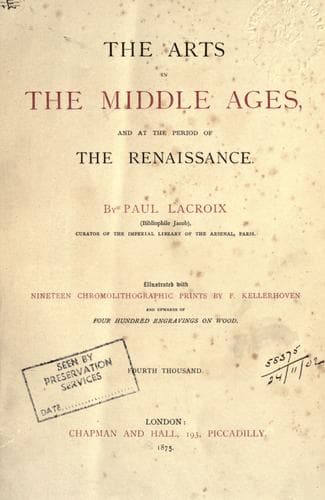
The Arts in the Middle Ages and at the Period of the RenaissanceJacob, P. L.
History
The Arts in the Middle Ages and at the Period of the Renaissance
Jacob, P. L.
Art, Medieval; Art, Renaissance; Middle Ages
To the same period we must refer the “Treatise on the Republic,” by
Cicero, which has but lately been found in a volume from which the
previous writing had been effaced, as was often the case (see PARCHMENT
AND PAPER), in order to make room for the new writing. For the fifth
century we have a second “Virgil,” with miniatures, which passed from
the library of the Abbey of St. Denis into that of the Vatican. The
“Prudence,” which the Imperial Library of Paris still possesses, is a
very fine manuscript of the sixth century, written, in rustic capitals,
quaint but elegant.
Two other kinds of writing were, at the same period, in use among the
Latins; this same rustic capital, ceasing to be rectangular, and rounded
in its principal strokes, became the uncial; and for that very reason
being much more expeditious, was reserved especially for the copying of
works; while the cursive, although sometimes employed for manuscripts,
was used chiefly in letter-writing. Of the first of these two writings,
the uncial, we have two fine specimens of the sixth century in the
“Sermons” of St. Augustine, on papyrus (Fig. 336), and in a Psalter of
St. Germain-des-Prés, written in letters of silver on purple vellum,
both of which now belong to the Imperial Library, Paris.
In the same century, we find a kind of writing called _half-uncial_,
which became more and more expeditious by the change made in certain of
its forms. There was then also a Gallican uncial, the form of which we
can see in the manuscript said to be by St. Prosper (Imperial Library,
Paris); and an uncial of Italy, among which figure the Bible of
Mont-Amiati, at Florence; the palimpsest[55] Homilies of the Vatican,
and the admirable Book of the Gospels at Notre-Dame, Paris (Fig. 337).
The most ancient style of cursive writing, employed in charts and
diplomas, is to be seen in the deeds known by the name of _charters of
Ravenna_, from the name of the town in which they were first discovered.
We may consider as analogous to these the writing of the Acts of our
early kings, very difficult to read on account of the exaggerated manner
in which the thin strokes join the letters together, and by the
indefinite forms of the up and down strokes. We give a fragment (Fig.
338) taken from an original chart, on parchment, of Childebert III. We
see what the same writing had become in 784 by Fig. 339, copied from an
original capitulary of Charlemagne.
Public-domain text, read in full here on John Shaqi.
Reviews
Reviews
No reviews yet
Be the first to share your thoughts on this work.
Elsewhere in the archive
Join the Discussion
Join the discussion
Sign in to leave a comment or review.
Sign InorCreate an account