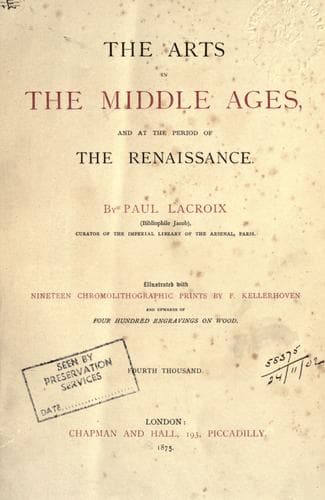
The Arts in the Middle Ages and at the Period of the RenaissanceJacob, P. L.
History
The Arts in the Middle Ages and at the Period of the Renaissance
Jacob, P. L.
Art, Medieval; Art, Renaissance; Middle Ages
The Sclavonic writing, which is also a daughter of Greece, has a history
nearly similar to that of the Mœso-Gothic. When the people of this
family were converted to Christianity, they were brought over to it by
Greek Christians, and the Patriarch Cyril, in the ninth century, became
their teacher; he taught them, how to write (which they never knew till
then), and it was the Greek alphabet they adopted, adding to it,
however, a few new signs, so that they might be able to express the
sounds peculiar to their language. Sclavonic manuscripts are positively
numerous in public libraries. We find them in Paris, Bologna, and Rome,
but above all in Germany, and in the country under the dominion of the
Muscovite. One of the most celebrated is that belonging to the town of
Rheims, and which is known by the name of “Texte du Sacre,” because a
tradition (an erroneous one, however) asserts that the kings of France,
at the time of their coronation at Rheims, took the oaths on this book,
which was said to be written by the hand of St. Procopius. The Sclavonic
manuscripts in general recommend themselves less by the elegance of
their execution than by the richness of their bindings.
The actual Russian alphabet is but an abridgment of the alphabet called
the _Cyrilian_, reduced to forty-two signs by the Emperor Peter I.; so
that the Sclavonic nations knew two _Cyrilian_ alphabets, the ancient
Sclavonic for the liturgical writings, and the modern Sclavonic, or
Russian, in general use. Of the first no manuscripts exist earlier than
the eleventh century of our era.
The manuscripts of the Latins are, without doubt, more numerous and more
varied, because the Latin Church is more extensive, and because Roman
civilisation spread itself over a larger number of European provinces.
At the head of the manuscripts of the Latin writing is placed a fragment
of papyrus, found in Egypt, on which is inscribed an imperial edict for
the annulment of a sale of property, agreed upon in consequence of some
violence committed by a certain man named Isidore; the date of this
document has been fixed as the third century. For the fourth century we
have the “Virgil,” with miniatures, which we mention elsewhere
(MINIATURES OF MANUSCRIPTS), and a “Terence,” both belonging to the
Vatican Library, and both written in capital letters; in the latter,
however, they are irregular, and called, on that account, _rustic
capitals_.
Public-domain text, read in full here on John Shaqi.
Reviews
Reviews
No reviews yet
Be the first to share your thoughts on this work.
Elsewhere in the archive
Join the Discussion
Join the discussion
Sign in to leave a comment or review.
Sign InorCreate an account