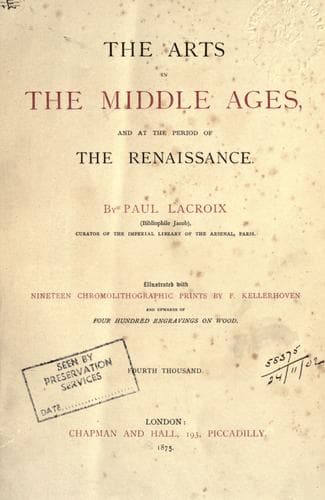
The Arts in the Middle Ages and at the Period of the RenaissanceJacob, P. L.
History
The Arts in the Middle Ages and at the Period of the Renaissance
Jacob, P. L.
Art, Medieval; Art, Renaissance; Middle Ages
In the eleventh century the minuscule of manuscripts was characterised
by its angular forms, which caused it to receive the name of _Capetian_.
Then the Capetian, exaggerated in its tendency towards its strokes and
angles, became the _Ludovician_, which announces the thirteenth century,
and characterises the reign of St. Louis.
[Illustration: Fig. 335.--Scribe or Copyist, in his Work-room,
surrounded by Open Manuscripts, and Writing at a Desk.
(From a Miniature of the Fifteenth Century.)]
However, manuscripts of the thirteenth century abound, and the history
of the writing of the period of St. Louis and of the three centuries
succeeding it, may be summed up in these words:--“The Capetian writing
called _Ludovician_, when it had come to differ still more from the
beautiful forms of the writings of Charlemagne’s time or the renovated
Roman, was more and more deformed, and these successive degradations
became so complicated that the writing, in the seventeenth century,
resulted in being perfectly illegible. Thus can be generalised all the
precepts relative to the state of writing, in the manuscripts and the
charters in France, for this period of three hundred years” (Fig. 343).
It was, however, the era of the richest manuscripts, that in which was
brought to perfection the art of ornamenting them, when the pencil of
the miniature-painter and the pen of the caligrapher, conjointly,
produced some masterpieces (Fig. 344). This was also the time when the
corporation of writers became numerous and powerful (Fig. 335). One of
the most distinguished members of this society was that Nicholas Flamel,
about whom so many fabulous legends have been invented. We give, as a
specimen of his magnificent cursive writing (Fig. 345), the fac-simile
of one of the _ex libris_ inscriptions he placed at the beginning of all
the books belonging to Duke Jean de Berry, whose secretary and
_bookseller_ he was.[56]
In other countries than France, in Germany especially, Gothic writing
was easily diffused. German manuscripts differ little from those of
France. We observe only that German writing continued to be very fine
till the middle of the thirteenth century, at which period it became
irregular, angular, and bristling with sharp points.
That which has just been said of Germany in particular is naturally
applicable to East and West Flanders, and to the Low Countries. During
the fifteenth century, under the impulse given by the Dukes of Burgundy,
whose influence we have already mentioned, the most important
chronicles, the best histories then extant, were magnificently
transcribed in that beautiful Gothic minuscule, thick, massive and
angular, which was called _lettre de forme_; and we find it again in
some ancient editions of the end of the fifteenth century (Fig. 346),
and of the beginning of the sixteenth.
Public-domain text, read in full here on John Shaqi.
Reviews
Reviews
No reviews yet
Be the first to share your thoughts on this work.
Elsewhere in the archive
Join the Discussion
Join the discussion
Sign in to leave a comment or review.
Sign InorCreate an account