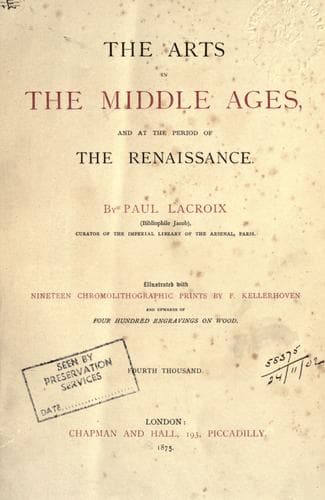
The Arts in the Middle Ages and at the Period of the RenaissanceJacob, P. L.
History
The Arts in the Middle Ages and at the Period of the Renaissance
Jacob, P. L.
Art, Medieval; Art, Renaissance; Middle Ages
In more northern countries the _Runic_ alphabet was made use of, to
which for a long while a marvellous origin was attributed, but which the
Benedictines justly regarded as an imitation, or rather as a corruption,
of the Latin alphabet. There exist in the _Runic_ language inscriptions
on stone and on wood, some manuscripts on vellum, and Irish books on
parchment and on paper.
In the south, the writing seems constantly to have reflected the lively
and frank spirit of its inhabitants, among whom was perpetuated the
profound impress of the old Roman civilisation. The minuscule continued
as high as it was long, thin, and distinct; even when it was altered by
the influence of the Gothic, it was still beautiful, and, above all,
legible, as we may be convinced of by examining a fine manuscript
entitled “Specchio della Croce” (“Mirror of the Cross”), of the
thirteenth century; and a precious manuscript of Dante, of the
fourteenth century, both belonging to the Imperial Library, Paris.
We may adopt for Spain the same opinions as for Italy. There was in
that country also writing of great merit, handed down from the Romans,
which received, as we have already said, the name of _Visigothic_. The
Visigothic writing of the eleventh and twelfth centuries, of the
eleventh especially, is a minuscule of the most graceful kind. But
Gothicism, by the _Capetian_ and the _Ludovician_ coming in as
intermediate agents, at last corrupted this elegant and delicate
writing, as we see in the collection of Spanish troubadours, formed by
order of John II., King of Castile and Leon, about 1440; a celebrated
manuscript in the Imperial Library, Paris.
Into England, where the Anglo-Saxon type reigned supreme, the Norman
conquest introduced the French writing in charters and manuscripts. And
lastly, among the writings called national, we must again mention that
of Ireland, of which there are fine examples remaining; but upon
examination they prove to be nothing but a variety of the Anglo-Saxon.
It is said to have been in use since the sixth century; and we find that
in spite of divers conquests it continued to be employed till the
fifteenth century. It was even known and employed in France, although it
by no means recommends itself by its elegance, as is attested, among
other manuscripts, by that of the “Homilies of St. Augustine,” in the
Imperial Library, Paris, which is supposed to belong to the eighth
century.
Here our summary review of palæographic examples at different periods of
the Middle Ages comes to an end. We might follow up our investigations
on this point, even after the time when the printing-press was invented,
since manuscripts are found of the reign of Louis XIV.; but they were
nothing but fanciful inutilities; each century, in order to show itself
in its true light, should follow the instincts and the inspirations
which belong to it.
FAC-SIMILE OF MANUSCRIPTS.
Public-domain text, read in full here on John Shaqi.
Reviews
Reviews
No reviews yet
Be the first to share your thoughts on this work.
Elsewhere in the archive
Join the Discussion
Join the discussion
Sign in to leave a comment or review.
Sign InorCreate an account