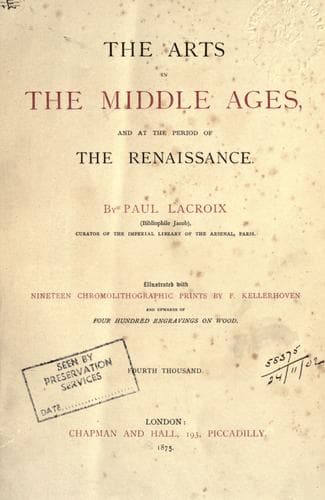
The Arts in the Middle Ages and at the Period of the RenaissanceJacob, P. L.
History
The Arts in the Middle Ages and at the Period of the Renaissance
Jacob, P. L.
Art, Medieval; Art, Renaissance; Middle Ages
Miniatures at the Beginning of the Middle Ages.--The two “Vatican”
Virgils.--Painting of Manuscripts under Charlemagne and Louis le
Débonnaire.--Tradition of Greek Art in Europe.--Decline of the
Miniature in the Tenth Century.--Origin of Gothic Art.--Fine
Manuscript of the time of St. Louis.--Clerical and Lay
Miniature-Painters.--Caricature and the Grotesque.--Miniatures in
Monochrome and in Grisaille.--Illuminators at the Court of France
and to the Dukes of Burgundy.--School of John Fouquet.--Italian
Miniature-Painters.--Giulo Clovio.--French School under Louis XII.
Contemporaneous, almost, with the idea which first caused oral
traditions, chronicles, speeches, and poetry to be collected together
under the form and name of _book_, is the art of ornamenting manuscripts
with miniatures. Our intention is not to go back to the sources--as
obscure as they are distant--of that art, but only to point out its
principal phases of improvement or of decay during the Middle Ages.
The most ancient known miniatures date from the very commencement of
that period which is generally called the Middle Ages; that is to say,
from the third and fourth centuries. These paintings, of which there
exist but two or three specimens in the libraries of Europe,
nevertheless offer, in their correctness and masterly beauty, the great
characteristics of ancient Art. The most celebrated are those of the
“Virgil,” preserved in the Vatican Library (Fig. 348), a manuscript long
celebrated among learned men for the authenticity of its text. Another
“Virgil,” of the date of about a century later, and which, before its
presentation to the Pope, was one of the most beautiful ornaments of the
ancient library of the Abbey of St. Denis, in France, contains paintings
not less remarkable in respect of colour, but very inferior as far as
drawing and the style of the compositions are concerned. These two
incomparable examples are sufficient in themselves to show the state of
the painting of manuscripts at the beginning of the Middle Ages.
[Illustration: Fig. 348.--Miniature taken from the “Virgil” in the
Library of the Vatican, Rome.
(Third or Fourth Century.)]
The sixth and seventh centuries have left us no books with miniatures;
the utmost we find at that period are some capital letters embellished
by caligraphy. In the eighth century, on the contrary, the ornaments
were multiplied, and some rather elegant paintings can be pointed out;
the fact is, under the reign of Charlemagne a movement of renovation
took place in the Arts as in literature: the Latin writing, which had
become illegible, was reformed, and the style of painting manuscripts
assumed something of the form of the fine antique examples still extant
at that period. (Fig. 350.)
[Illustration: Fig. 349.--Painted Capital letters, taken from
Manuscripts of the Eighth or Ninth Century.]
Public-domain text, read in full here on John Shaqi.
Reviews
Reviews
No reviews yet
Be the first to share your thoughts on this work.
Elsewhere in the archive
Join the Discussion
Join the discussion
Sign in to leave a comment or review.
Sign InorCreate an account