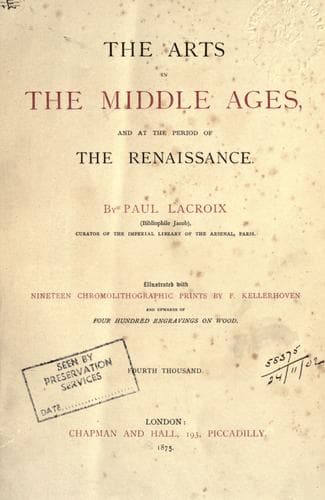
The Arts in the Middle Ages and at the Period of the RenaissanceJacob, P. L.
History
The Arts in the Middle Ages and at the Period of the Renaissance
Jacob, P. L.
Art, Medieval; Art, Renaissance; Middle Ages
medallions representing divers episodes suggested by the text of the
Psalms (Fig. 361). After this psalter we must place the Breviary of St.
Louis, or rather of Queen Blanche, formerly preserved in the Arsenal
Library, Paris, and now in the Musée des Souverains; a celebrated
manuscript which has, on folio 191, this inscription: “C’est le Psautier
monseigneur St. Loys, lequel fu à sa mère.”[57] But the volume is not
rich in large miniatures. We observe in it, however, a calendar
ornamented with small subjects very delicately executed, representing
the labours appropriate to each month, according to the seasons of the
year. The character of the paintings exhibits a style anterior to the
reign of Louis IX.; and it is supposed, indeed, that this book first
belonged to the mother of that king.
We must now mention another Psalter, which was actually used by St.
Louis; as is proved not only by an inscription at the beginning of the
volume, but still further by the fleurs-de-lis of the king, the arms of
Blanche of Castile, his mother, and perhaps also _les pals de gueules_
of Margaret of Provence, his wife. Nothing can equal the beautiful
preservation of the miniatures in this volume, which contains
seventy-eight subjects, with as many explanatory texts in French. The
heads of the characters, though almost microscopic, have nevertheless,
generally, a fine expression.
[Illustration: Fig. 362.--A Border taken from a Gospel in Latin, of the
Thirteenth Century.
(Imperial Library, Paris.)]
The “Livre de Clergie,” which bears the date of 1260, merits far less
attention: so does the “Roman du Roi Artus,” No. 6,963, in the Imperial
Library, Paris, executed in 1276. But we must point out two of the most
beautiful examples of this period, a Book of the Gospels in Latin, No.
665 in the Supplement, Imperial Library, from which we have borrowed an
elegant border (Fig. 362), and the “Roman du Saint-Graal,” No. 6,769,
also in the Imperial Library.
Italy was then at the head of civilisation in everything; it had
particularly inherited the grand traditions of painting which had gone
to sleep for ever in Greece only to wake up again in Europe.
[Illustration: Fig. 363.--Facsimile of a Miniature of the Thirteenth
Century, representing a scene of an old Romance: the beautiful Josiane,
disguised as a female juggler, playing a Welsh air on the _Rote_
(Fiddle), to make herself known to her friend Bewis. (Imperial Library,
Paris.)]
Public-domain text, read in full here on John Shaqi.
Reviews
Reviews
No reviews yet
Be the first to share your thoughts on this work.
Elsewhere in the archive
Join the Discussion
Join the discussion
Sign in to leave a comment or review.
Sign InorCreate an account