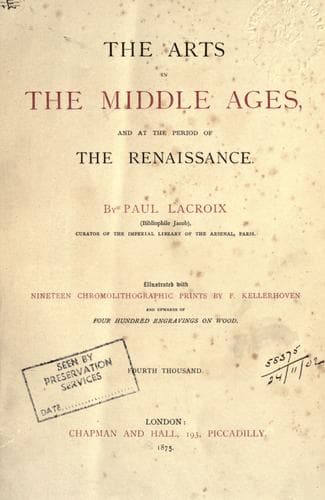
The Arts in the Middle Ages and at the Period of the RenaissanceJacob, P. L.
History
The Arts in the Middle Ages and at the Period of the Renaissance
Jacob, P. L.
Art, Medieval; Art, Renaissance; Middle Ages
Here we must introduce a remark, the result of a general examination of
the manuscripts bequeathed to us by the thirteenth century; namely, that
the miniatures in sacred books are much more beautifully and carefully
executed than those of the romances of chivalry and the chronicles of
the same period (Figs. 363 and 364). Must we attribute this superiority
to the power of religious inspiration? Must we suppose that in the
monasteries alone clever artists met with sufficient remuneration?
Before answering these questions, or rather as an answer to them, let us
remember that in those days religious institutions absorbed nearly all
the social intellectual movement, as well as the effective possession of
material riches, if not of territorial property. Solely occupied with
distant wars or intestine quarrels which impoverished them, the nobles
were altogether unable to become protectors of literature and Art. In
the abbeys and convents were lay-brethren who sometimes had taken no
vow, but whose fervent spirits, burning with poetical imagination,
sought in the monastic retreat redemption from their past sins: these
men of faith were happy to consecrate their whole existence to the
ornamentation of a single sacred book destined for the community which
gave them in exchange all the necessaries of life.
[Illustration: Fig 364.--The Four Sons of Aymon on their good Steed,
Bayart. From a Miniature in the Romance of the “Four Sons of Aymon,” a
Manuscript of the Thirteenth Century. (Imperial Library, Paris.)]
This explains the absence of the names of the miniature-painters in
ancient manuscripts, particularly in those which are written in Latin.
However, when romances and chronicles in the vulgar tongue began to come
into fashion, artists of great talent eagerly presented themselves to be
engaged by princes and nobles who wished to have this sort of books
ornamented; but the anonymous which these lay artists generally
preserved is explained by the circumstance that in most cases they were
considered only as artistic assistants in the lordly houses where they
were employed, and in which they fulfilled some other domestic duty; for
instance, Colard de Laon, the favourite painter of Louis of Orleans, was
also valet-de-chambre to this prince; Pietro Andrea, another artist,
doubtless an Italian, to judge from his Christian name, was
gentleman-usher; and we see this
[Illustration: Fig. 365.--Miniature taken from the “Roman de Fauvel”
(Fifteenth Century), representing Fauvel, or the Fox, reprimanding a
Widow who has married again, and to whom is being given a Serenade of
Rough Music.
(Imperial Library, Paris.)]
same painter “sent from Blois to Tours, to procure certain matters for
the accouchment of Madame the Duchess;” or again, “from Blois to
Romorantin, to inquire after Madame d’Angoulesme, who was reported to be
very unwell.”
Public-domain text, read in full here on John Shaqi.
Reviews
Reviews
No reviews yet
Be the first to share your thoughts on this work.
Elsewhere in the archive
Join the Discussion
Join the discussion
Sign in to leave a comment or review.
Sign InorCreate an account