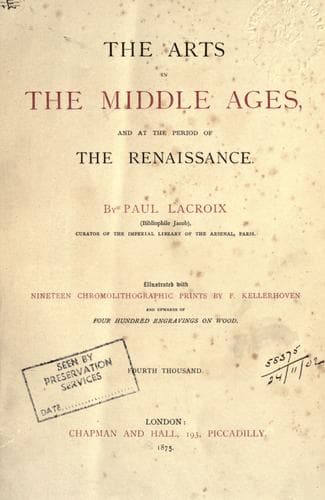
The Arts in the Middle Ages and at the Period of the RenaissanceJacob, P. L.
History
The Arts in the Middle Ages and at the Period of the Renaissance
Jacob, P. L.
Art, Medieval; Art, Renaissance; Middle Ages
Certain artists, however, who then took the modest name of illuminators,
lived entirely by their profession; working at _tableaux benoîts_
(blessed pictures), or popular paintings, which were sold at the
church-doors. Others, again, were paid assistants of the recognised
painters to princes or nobles; and the anonymous was quite naturally
imposed upon them by their subordinate position, if not by the simple
modesty which was for a long time the accompaniment of talent. In the
fourteenth century the study of miniatures is peculiarly interesting, on
account of the scenes of public and private life, of manners and
customs, we find reproduced in them. Portraits after life, _d’après le
vif_, as they were called in those days, made their appearance; and
caricature, at all times so powerful in France, already began to show
itself with a daring which, occupying itself with the clergy, women, and
chivalry, stopped only before the prestige of royalty.
The miniatures of a French manuscript, dated 1313 (Imperial Library,
Paris, No. 8,504, F. L.), deserve to be mentioned, especially on account
of the various subjects they represent; for, besides the ceremony of the
reception of the King of Navarre into the order of chivalry, we see in
it philosophers discussing, judges administering the law, various scenes
of conjugal life, singers accompanying themselves on divers instruments
of music, villagers engaged in the labours of country life, &c. We must
mention also a manuscript of the “Roman de Fauvel,” in which is
especially prominent the very original scene of a popular concert of
rough music, by masked performers, given, according to an old custom, to
a widow who had married a second time (Fig. 365).
The period during which Charles V. occupied the throne of France is one
of those that produced the finest specimens of manuscript-painting. This
monarch, the founder of the Royal Library, was an admirer of illustrated
books, and had accumulated, at great cost, a large collection in the
great tower of the Louvre. A royal prince, whom we have already
mentioned as being excessively devoted to artistic luxuries, was the
rival of Charles V. in this respect: this was his brother, the Duke Jean
de Berry, who devoted enormous sums to the purchase and production of
manuscripts.
[Illustration: Fig. 366.--Border taken from a Prayer-book belonging to
Louis of France, Duke of Anjou, King of Naples, of Sicily, and of
Jerusalem. (Fourteenth Century.)]
[Illustration: Fig. 367.--Miniature taken from “Les Femmes Illustres,”
translated from Boccacio. (Imperial Library, Paris.)]
Public-domain text, read in full here on John Shaqi.
Reviews
Reviews
No reviews yet
Be the first to share your thoughts on this work.
Elsewhere in the archive
Join the Discussion
Join the discussion
Sign in to leave a comment or review.
Sign InorCreate an account