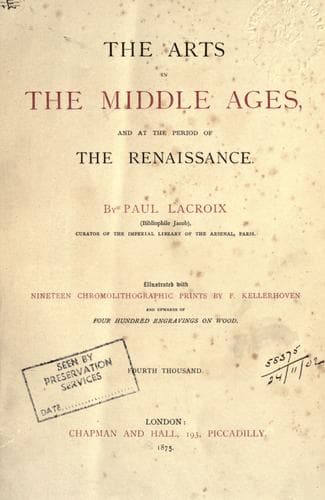
The Arts in the Middle Ages and at the Period of the RenaissanceJacob, P. L.
History
The Arts in the Middle Ages and at the Period of the Renaissance
Jacob, P. L.
Art, Medieval; Art, Renaissance; Middle Ages
Would it not have been surprising that the pilgrims who were to visit
Aix-la-Chapelle on the occasion of the grand jubilee of 1440, should be
so anxious to buy ornamented mirrors? As to the art “_of polishing
stones_,” which Gutenberg had taught at first to Andrew Dritzehen, who
derived from it “_so much profit_,” having anything to do with printing
was, no doubt, also questionable; but we have not been able to solve the
enigma, and wait to clear up the difficulty till a new _incunable_
(_incunabula_, “a cradle,” the word is applied to the first editions
ever printed) is discovered, the work of some Peter (πἑτρος “a stone”)
or other; as, for example, the Latin sermons of Hermann de Petra on the
Lord’s Prayer; for Gutenberg, when speaking of _polishing stones_, might
have enigmatically designated a book he was printing; just as his
partner, in answer to the judge, after having raised his hand on high
and sworn to give true evidence, could call himself _a maker of
mirrors_, without telling a falsehood, without committing perjury. The
secret of printing was to be religiously kept by those who knew it.
In short, it results from all this that Gutenberg, “an ingenious man and
a man of invention,” having seen a xylographie “Donatus,” had
endeavoured to imitate it, and had succeeded in doing so, the secret
being confided to Andrew Dritzehen; that the other _arts_, which
Gutenberg at first kept to himself, but which he subsequently
communicated to his partners, consisted in the idea of substituting
movable type for tabular printing; a substitution that could only be
effected after numerous experiments had been made, and which were just
about to be crowned with success when Andrew Dritzehen died. We may then
consider it as nearly certain that printing was in some sort discovered
twice successively--the first time by Laurent Coster, whose small
printed books, or books in letterpress (_en moule_), attracted the
attention of Gutenberg; and the second time by Gutenberg, who raised the
art to a degree of perfection such as had never been attained by his
predecessor.
Public-domain text, read in full here on John Shaqi.
Reviews
Reviews
No reviews yet
Be the first to share your thoughts on this work.
Elsewhere in the archive
Join the Discussion
Join the discussion
Sign in to leave a comment or review.
Sign InorCreate an account