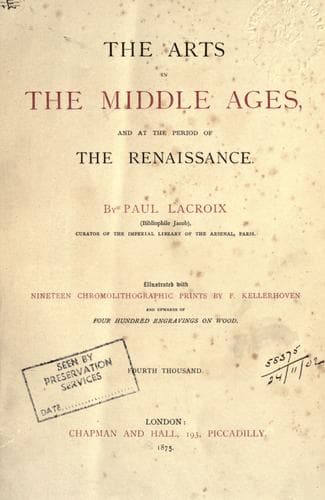
The Arts in the Middle Ages and at the Period of the RenaissanceJacob, P. L.
History
The Arts in the Middle Ages and at the Period of the Renaissance
Jacob, P. L.
Art, Medieval; Art, Renaissance; Middle Ages
Glass and glazing claim particular notice. It may be said that glass was
known in the remotest ages, for Phœnicia and ancient Egypt were, in the
time of Moses, renowned for their innumerable productions in vitrified
sand. In Rome they cast, cut, and engraved glass--they even worked it
with the hammer, if we are to believe Suetonius, who relates that a
certain artist had discovered the secret of making glass malleable. This
industrial art, which extended and improved under the emperors, found
its way to Byzantium, where it flourished during several centuries;
until Venice, claiming as she then did a prominent position in the
history of the arts, imported the process of the Byzantine method of
making glass, and in her turn excelled in this manufacture. Although
articles in glass and crystal, painted, enamelled, and engraved, are
frequently alluded to in historical and poetical narratives, and also in
the inventories of the Middle Ages, we know they were all the result of
Greek or Venetian manufacture. In this art France especially seems to
have been somewhat late in taking her first artistic step; such
[Illustration: Fig. 16.--Bolt of the Sixteenth Century, with Initial of
Henry II.
(In the Castle of Chenonceaux.)]
[Illustration: Fig. 17.--Key of the Thirteenth Century, with two Figures
of Chimeras, back to back.
(Soltykoff Collection.)]
objects as were manufactured for the use of the rich never passed beyond
the limits of the rudest art. We should, however, observe that France
must have long been acquainted with the art of glazing, for in the
middle of the seventh century we find St. Benoît--called Biscop, who
built so many churches and convents in England--coming to France in
search of workmen for the purpose of glazing the church and the
cloisters of his abbey at Canterbury. And it is also mentioned in the
chronicles of the Venerable Bede, that the French taught their art to
the English glaziers.
Towards the fourteenth century the windows of even the commonest houses
were generally glazed; at that date glass manufactories were found in
operation everywhere; and although they may not have rivalled in a
remarkable degree their predecessors of the Merovingian period, they
nevertheless made in large quantities all kinds of articles ordinarily
in use, as we can judge by the terms of a charter, dated 1338, by which
one Guionnet, in order to have the privilege of establishing a glass
factory in the forest of Chambarant, was bound to furnish as an annual
due to his seigneur, Humbert, Dauphin of Viennois, one hundred dozen
glasses in the shape of a bell, twelve dozen small shallow glasses,
twenty dozen goblets, twelve dozen amphoræ, twenty dozen lamps, six
dozen candlesticks, one dozen large cups, one large stand (or _nef_),
six dozen dishes without borders, twelve dozen jars, &c.
Public-domain text, read in full here on John Shaqi.
Reviews
Reviews
No reviews yet
Be the first to share your thoughts on this work.
Join the Discussion
Join the discussion
Sign in to leave a comment or review.
Sign InorCreate an account