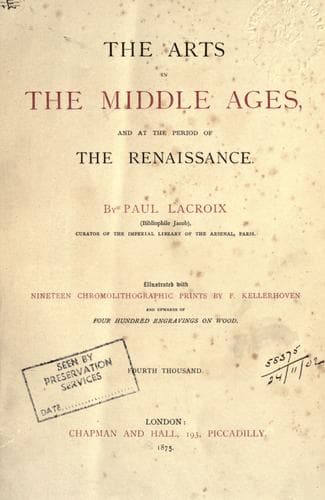
The Arts in the Middle Ages and at the Period of the Renaissance — John Shaqi
The Arts in the Middle Ages and at the Period of the RenaissanceJacob, P. L.
History
The Arts in the Middle Ages and at the Period of the Renaissance
Jacob, P. L.
Art, Medieval; Art, Renaissance; Middle Ages
We know that in the early days of Christianity the rite of baptism was
performed by immersion in rivers or in fountains, but at a period nearer
to our own time, basins or vessels of various dimensions were placed in
a small detached edifice, by the side of the church; into these the
neophytes were plunged when receiving the first sacrament. These
baptistries disappeared as soon as the practice of sprinkling holy water
on the forehead of the catechumen was definitely substituted for that of
immersion. Baptismal fonts then became what they now are, that is, a
kind of small erection above the level of the floor--piscinas, shells
(_vasques_), or basins, recalling to our minds, though on a reduced
scale, the primitive baptistries. They were placed inside the church,
either near the entrance, or in one of the side-chapels. At various
periods they were made of stone, marble, or bronze; and were ornamented
with subjects relating to the rite of baptism. It was the same with the
holy-water basins, which, according to ancient custom, were placed at
the entrance to the church, and generally assumed the form of a shell,
or of a large amphora, when not made simply of a hollowed stone to
recall the ancient baptismal vessels.
[Illustration: Fig. 25.--Bas-relief in carved wood, representing a
Domestic Scene, from the Stalls called “Miséricordes,” in the Choir of
the Cathedral of Rouen (Fifteenth Century).]
We must not overlook the altar and procession-crosses, which, as being
typical of the divine emblem of the Christian faith, could not fail to
become real objects of art even from the time of the catacombs. It would
be needless repetition to enumerate here the different materials used in
the manufacture of crosses, the various shapes that were given to them,
according to the purpose for which they were intended, and the subjects
and figures they represented. The sculptor, the modeller, the chaser,
the enameller, and even the painter, were associated with the goldsmith
in producing most exquisite works of this kind. The art of the
wood-carver and that of the worker in iron, which we have seen executing
such marvels for household furniture, could not fail to find scope in
the manufacture of objects used for religious purposes. It was
especially in making pulpits, ornamental screens, wainscoting, and
stalls, that the art of the wood-carver became renowned; he was no
longer simply an artisan, but became an artist of the highest order. In
the ornamentation of railings of choirs and tombs, the iron-work on
doors, of bolts, locks, and keys, the remarkable talent of the
locksmiths of the Middle Ages was displayed. Let us here remark, that in
the early days of worship the pulpit was simply a kind of stool on which
the preacher stood in order that his congregation might see him. By
degrees the pulpit was raised on supports or columns; and later again,
but only towards the end of the fifteenth century, we find it fixed at a
Public-domain text, read in full here on John Shaqi.
Reviews
Reviews
No reviews yet
Be the first to share your thoughts on this work.
Join the Discussion
Join the discussion
Sign in to leave a comment or review.
Sign InorCreate an account