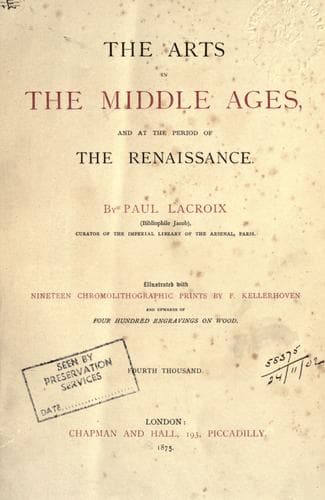
The Arts in the Middle Ages and at the Period of the RenaissanceJacob, P. L.
History
The Arts in the Middle Ages and at the Period of the Renaissance
Jacob, P. L.
Art, Medieval; Art, Renaissance; Middle Ages
We have just intimated it was at Saintes that Palissy, when in search of
immortal fame, underwent his rude apprenticeship. A short time after he
had attained these definite results, religious questions having caused
some disturbances in Saintonge, the Constable de Montmorency, who had
been sent to suppress the Huguenot rising, had an opportunity of seeing
Palissy’s works: he requested that he should be presented to him, and at
once declared himself his friendly protector. And we must take this word
protector in its widest sense, for the potter, who had zealously
embraced the doctrines of the Reformation, and who subsequently
preferred to be imprisoned for life rather than abjure his faith (if he
did not die in the Bastille, at least he was imprisoned there at the
time of the Massacre of St. Bartholomew), indeed required protection, as
much for the exercise of liberty of conscience as for carrying on his
artistic labours. After Montmorency had commissioned him to execute some
considerable works, which also gained him the patronage of several
important personages, he obtained for him the favour of royalty. Palissy
was summoned to Paris, and received the title of “inventeur des
rustiques figulines du roi et de la reine-mère”--Henri II. and Catherine
de Médicis. He was lodged in the Tuileries; and was not long there
before he became renowned, not only for his ceramic productions, but
also for his scientific knowledge.
In the recent building operations at the Tuileries, on digging a trench
in the garden, the workshop of Bernard Palissy was discovered; being
recognised by fragments and various pieces of enamelled pottery with
figures in relievo. Among these was found a large fragment of the dish
of Palissy, known under the name of the Baptismal Dish, on account of
the subject represented thereon. In July, 1865, while excavating in the
part of the palace where the “Salle des Etats” has been built, the
workmen discovered, below the level of the surface soil, two ovens for
baking pottery, in a tolerably good state of preservation. One contained
pieces of those muffles (_gazettes_) Palissy is said to have invented,
and which were employed in baking delicate pieces of work--imprints of
various kinds of ornaments, and figures in altorelievo: two of these
are described by Palissy himself in the “Devis d’une grotte pour la
royne, mère du roy” (“device of a grotto for the queen, the king’s
mother”), and which he thus indicates in the following sentence:--“I
should wish to make certain figures from nature, following her so
closely, even to the small hair in the beard and eyebrows, as to make
them the natural size.” These peculiarities are to be seen in the
fragments of the moulds which have been discovered. In the same page
Palissy says, “Also there would be another, composed completely of
sea-shells of different kinds; that is to say, the two eyes of two
shells, the nose, mouth, and chin, forehead and cheeks, all made out of
Public-domain text, read in full here on John Shaqi.
Reviews
Reviews
No reviews yet
Be the first to share your thoughts on this work.
Elsewhere in the archive
Join the Discussion
Join the discussion
Sign in to leave a comment or review.
Sign InorCreate an account