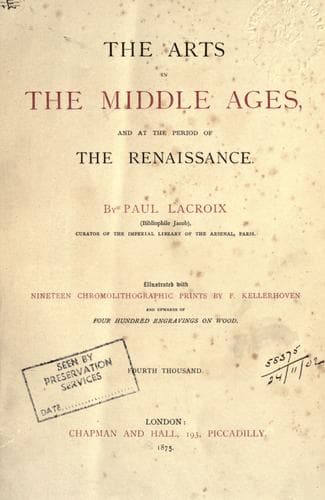
The Arts in the Middle Ages and at the Period of the RenaissanceJacob, P. L.
History
The Arts in the Middle Ages and at the Period of the Renaissance
Jacob, P. L.
Art, Medieval; Art, Renaissance; Middle Ages
sea-shells, as well as even the remainder of the body.” This was found
in fragments, as also a hand moulded from nature, and holding a sword of
ancient make (Fig. 39). Among the fragments moulded from the naked and
the draped form, is the one which we give (Fig. 40); it is thus
described by Palissy:--“Also for the sake of astonishing mankind, I
wished to make three or four (figures) draped, and with their hair
dressed in quaint ways, whose dresses and head-dresses shall be of
divers linen, cloths, or striped materials so natural that no man would
think but it was the object itself which the workman had wished to
imitate.”[4]
[Illustration: Fig. 38.--Ornamentation on Pottery by Bernard Palissy.]
We thus see how Palissy, called “Maître Bernard des Thuilleries,”
deserved the esteem of the sovereigns who desired he should be near
them.
M. Jacquemart says of Palissy ware:--“It is remarkable in more ways than
one--for its white paste with a shade of yellowish grey, for its
hardness, and its infusibility, equalling that of fine earthenware or
pipe-clay. These give it a special character, that distinguishes it from
Italian productions, the clay of which is of a dirty and dusky red. The
enamel has great brilliancy; it is hard, and is not unfrequently wavy
(_tresaille_). The colours vary a little, but they are bright--pure
yellow, yellow ochre, indigo blue, grey blue, emerald green produced
from copper, yellow green, violet brown, and manganese violet. As for
the white, it is somewhat dull, and cannot be compared with Luca della
Robbia ware; wherefore the most persevering researches of Palissy, who
invented all the processes which he employed in his work, aimed at the
attainment of greater brilliancy. The under part of Palissy ware is
never of a uniform tone of colour; it is spotted or tinted with blue,
yellow, and violet brown.
[Illustration: Figs. 39 and 40.--Fragments of Figures on which the
moulds have been found in one of Palissy’s Ovens at the Tuileries.]
“It would be exceedingly difficult, not to say impossible, to enumerate
the various shapes he was able to give to his enamelled ware. Combining
in
[Illustration: Fig. 41.--Goblet, by Bernard Palissy. (Museum of the
Louvre.)]
Public-domain text, read in full here on John Shaqi.
Reviews
Reviews
No reviews yet
Be the first to share your thoughts on this work.
Elsewhere in the archive
Join the Discussion
Join the discussion
Sign in to leave a comment or review.
Sign InorCreate an account