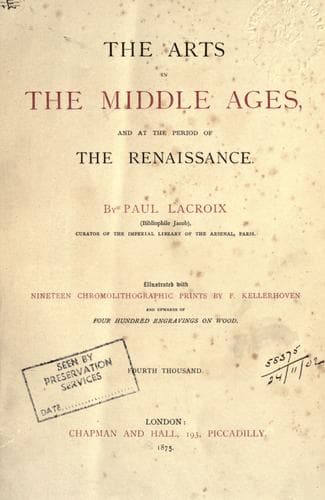
The Arts in the Middle Ages and at the Period of the RenaissanceJacob, P. L.
History
The Arts in the Middle Ages and at the Period of the Renaissance
Jacob, P. L.
Art, Medieval; Art, Renaissance; Middle Ages
[Illustration: Fig. 45.--Ornament of a Dish, Italian ware. (Collection
of M. le Baron Alph. de Rothschild.)]
ARMS AND ARMOUR.
Arms of the Time of Charlemagne.--Arms of the Normans at the Time
of the Conquest of England.--Progress of Armoury under the
Influence of the Crusades.--The Coat of Mail.--The Crossbow.--The
Hauberk and the Hoqueton.--The Helmet, the Hat of Iron, the
Cervelière, the Greaves, and the Gauntlet; the Breastplate and the
Cuish.--The Casque with Vizor.--Plain Armour and Ribbed
Armour.--The Salade Helmet.--Costliness of Armour.--Invention of
Gunpowder.--Bombards.--Hand-Cannons.--The Culverin, the
Falconet.--The Arquebus with Metal-holder, with Match, and with
Wheel.--The Gun and the Pistol.
The most ancient and authentic document that presents to us a just and
almost perfect idea of the arms in use towards the end of the eleventh
century, is the celebrated tapestry of Bayeux, of which we have already
spoken.
It is sufficient to examine with some attention that complex and
illustrated narrative of the conquest of England in 1066, to learn what
was the general aspect of war at that period. But any one who has at all
studied the ancient historians and the annals of our earliest career as
a people, will not fail to recognise, as so many constituent parts
combining to form the equipment of war, most of those weapons that were
adopted among various races, the contests and the union of which was to
give birth to modern nations.
If we can rely on the testimony of some miniatures in manuscripts of the
time of Charlemagne, Roman customs are constantly recalled in the
costume and arms of the warriors of the eighth and ninth centuries (Fig.
46), “but with the modifications necessarily resulting from
contemporaneous corrupt taste,” as observed by M. de Saulcy, whom, it
may be remarked, we follow step by step, as it were, in the labours
which he has conscientiously devoted to the history of warlike arms;
“for at that time the helmets, the bucklers, and the swords had assumed
forms very unlike the models whereof they were supposed to be an
imitation. One can readily imagine that costume had become subjected to
the same sort of change as language, corrupted as this was by the
admixture of German manners with those of the nations subjected to
Rome.”
In the middle of the ninth century the Normans disembarking, possessed
themselves of Neustria, and introduced among the French nation, with
which they at first contended, and at length concluded a peace, an
entire series of defensive arms entirely novel in form, if not in their
nature. It is then, according to certain learned men, that warriors are
seen, in illustrated manuscripts, attired in dresses furnished with
small rings or iron scales, wearing pointed helmets, and using shields
cut horizontally above, and terminating at the base in a point more or
less sharp.
Public-domain text, read in full here on John Shaqi.
Reviews
Reviews
No reviews yet
Be the first to share your thoughts on this work.
Elsewhere in the archive
Join the Discussion
Join the discussion
Sign in to leave a comment or review.
Sign InorCreate an account