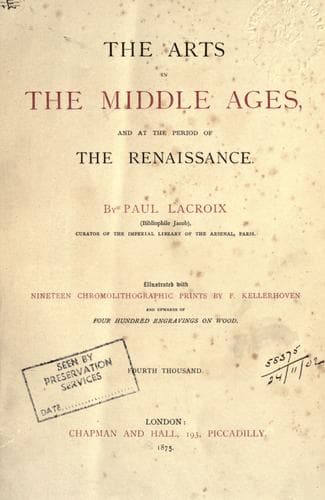
The Arts in the Middle Ages and at the Period of the RenaissanceJacob, P. L.
History
The Arts in the Middle Ages and at the Period of the Renaissance
Jacob, P. L.
Art, Medieval; Art, Renaissance; Middle Ages
[Illustration: Fig. 46.--Gallo-Romano Soldiers. Fac-simile of Miniatures
in the MS. of Prudentius. (Imp. Library of Paris.)]
In the Bayeux tapestry we see the army of William that fought the battle
of Hastings composed of three different bodies of troops: the archers,
light infantry, armed with arrows and darts; foot-soldiers, or Heavy
infantry, using weightier arms, and clad in iron mail; and cavalry, in
the midst of which figures the Duke William (Fig. 47).
The costume exhibits little variety; only two sorts of accoutrements are
observable; one very plain, worn by men who have no helmet, is evidently
that of an inferior soldier; the other, covered with iron rings, not
interlaced, extends from the shoulders to the knees, and belongs only
to warriors whose head-dress is a narrow, conical helmet, more or less
sharply pointed, extending behind (_en couvre nuque_) to cover the nape
of the neck (Fig. 48), and in front provided with a metal protector for
the face, called the _nasal_.
Among the horsemen thus encased in iron, are some who have boots and
stirrups, others are without them, and even wear no spurs. Their shields
are convex, secured to the arm by a leather strap, generally circular at
top, and terminating in a point below. Some, however, are polygonal and
convex, and in the centre show a rather long point.
[Illustration: Fig. 47.--King William, as represented on his seal
preserved in England.]
[Illustration: Fig. 48.--Lancer of William’s Army.]
Offensive arms consist of swords, axes, lances, javelins, and arrows.
The swords are long, of uniform width nearly to the extremity which
comes abruptly to a point, and have heavy, strong hilts. The axes
exhibit no remarkable peculiarity. The spears terminate in an iron
point, probably sharpened, and equal in length to one-sixth of the
handle. We see also clubs, maces, and, finally, pronged staves (_bâtons
fourchus_), doubtless the earliest form of the weapon; these last were
subsequently called _bisaguë_, and, with maces and clubs, were
ordinarily used by serfs and peasants; the sword and the spear being
reserved for freemen.
The sling is not to be found in the hands of any warrior; but it is
remarkable that, in the border of the Bayeux tapestry, it is used by a
peasant aiming at a bird; from which it may be inferred that the sling
had become a mere weapon for field-sport. Moreover, this was also the
case with the bow among the French; which was again held in honour after
the advent of the Normans, especially since the latter could ascribe to
it their success at the battle of Hastings, where Harold, the opponent
of William, was killed by an arrow. Nevertheless, the statutes of the
Conqueror, who himself excelled with the bow, did not include that
weapon among those of the nobility.
Public-domain text, read in full here on John Shaqi.
Reviews
Reviews
No reviews yet
Be the first to share your thoughts on this work.
Elsewhere in the archive
Join the Discussion
Join the discussion
Sign in to leave a comment or review.
Sign InorCreate an account