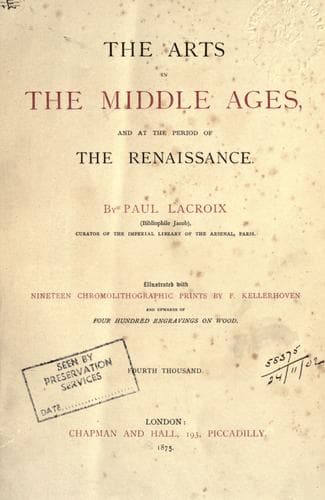
The Arts in the Middle Ages and at the Period of the RenaissanceJacob, P. L.
History
The Arts in the Middle Ages and at the Period of the Renaissance
Jacob, P. L.
Art, Medieval; Art, Renaissance; Middle Ages
From the conquest of the Normans to the Crusades, we scarcely find
anything worth notice, except the adoption of a very murderous implement
of war, which acquired the name of the flail, or armed whip (_fléau_, or
_fouet d’armes_); it was formed of iron balls studded with points, and
was attached to the end of a strong staff by small chains. But we come
to a period when the events which occurred in Asia had a considerable
influence on the arms and the military costume of Europe. The first and
principal of the importations due to those distant expeditions was that
of the coat of mail, then in common use among the Arabs, and which has
since been discovered in the sculptures of the period of the Sassanidæ,
a royal race that ruled over Persia from the third to the seventh
century.
It is not affirmed that prior to the first crusade we had no knowledge
of iron chain-work, of which the Orientals made defensive helmets; but
we imitated it only in a heavy and clumsy manner. This armour, which was
of ponderous weight, and, besides, was far from rendering invulnerable
those who were burdened with it, had not displaced the _haubergeons_,
the _jacques de fer_, the _brigandines_, the _armures à macles_ (Fig.
49), (such were the names given to the cuirasses of leather and of cloth
covered with metal plates); but when such defensive armour came to be
better known, with all its original good qualities; and when we had
learned to make it according to the Oriental method, there was no
further delay in adopting that network of iron (_tricot_) at once
flexible, light, and, in some degree, impenetrable. However, since the
manufacture of ancient armour was more simple, and consequently less
costly, it was not altogether abandoned. It is only so late as the time
of Philip Augustus and Louis IX. (the thirteenth century) that the use
of coats of mail became general; to this some knights attached mail
hose, to protect the thighs, legs, and feet (Fig. 50).
In the reign of Louis le Gros (twelfth century) we see the first attempt
at a movable vizor adapted to the conical helmet of the Normans; and to
the same period must be referred the invention of the crossbow: or, it
may rather be said that a stock, or _arbrier_, was added to the bow,
which afforded greater facility for stretching the string, and also
aided in directing the arrow. This new weapon, after being exclusively
used in the chase, appeared in warfare; but, in 1139, Pope Innocent II.,
confirming the decisions of the Council of Lateran, which had condemned
it as too destructive, prohibited its use. The crossbow was not restored
to military equipments until the third crusade, under Richard Cœur de
Lion, who, having permitted his men to resume the weapon, was
subsequently assumed to have invented it.
[Illustration: Fig. 49.--Norman Archer.]
[Illustration: Fig. 50.--Jean Sansterre, as represented on his Seal.
Reproduced by Meyrick.]
Public-domain text, read in full here on John Shaqi.
Reviews
Reviews
No reviews yet
Be the first to share your thoughts on this work.
Elsewhere in the archive
Join the Discussion
Join the discussion
Sign in to leave a comment or review.
Sign InorCreate an account