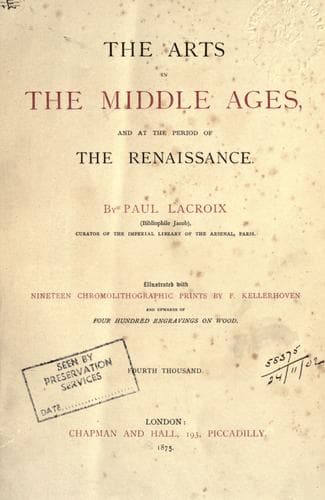
The Arts in the Middle Ages and at the Period of the RenaissanceJacob, P. L.
History
The Arts in the Middle Ages and at the Period of the Renaissance
Jacob, P. L.
Art, Medieval; Art, Renaissance; Middle Ages
Under John the Good, that is, in the middle of the fourteenth century,
plain armour was generally adopted; the long coat of mail, heavier and
less convenient, was entirely abandoned; but chain-armour still covered
certain parts of the body not yet protected by iron plates. The
_bassinet_, then very pointed, was furnished with mail, covering the
neck and a portion of the shoulders. The upper part of the arm was
protected by a half-armlet, called the _épaulette_, but the lower part
was provided with mail.
Ornaments began to be introduced in armour in the reign of Charles V.;
until that time it had a simple and plain appearance. For instance, the
_camail_ of the _bassinet_ is embroidered on the shoulders with gold and
silver, and the point surmounting it is decorated with an imitation of
foliage--an ornament which, according to the “Chronicle of Du Gueslin,”
had the disadvantage of presenting a kind of handle to an opponent. The
cuirass, to which it was then deemed sufficient to impart a bright
polish, or to paint in ordinary colours, sometimes bright, sometimes
dark, began to be engraved and chased towards the end of the following
reign.
In the time of Charles VI. there was introduced, for the first time,
four or five flexible plates, called _faldes_, which protected the lower
part of the stomach without impeding the movements of the body. A little
later, _tassettes_ were added; they were attached to the top of the
thigh to guard the hips and the groin. It appears that at this period
the artisans of Milan, were especially renowned for the manufacture of
armour; for Froissart relates that Henry IV., King of England, when Earl
of Derby,[7] and preparing to enter the lists with the Duke of Norfolk,
requested armour from Galeas, Duke of Milan, who sent it with four
Milanese armourers. The swords and spears made at Toulouse and at
Bordeaux were also held in great repute; so also were the double-handed
swords in use from the middle of the thirteenth century, and
manufactured at Lubeck, in Germany. The steel helmets of Montauban were
also much in request.
Towards the commencement of the fifteenth century, engines of war,
distinct from those in which powder was used, had attained a remarkable
degree of perfection. When John the Fearless, Duke of Burgundy, marched
upon Paris, in 1411, there was with his army a considerable number of
machines called _ribaudequins_, a species of gigantic crossbow drawn by
a horse, and which with enormous strength threw javelins to a great
distance.
Under Charles VII., the breastplate of the cuirass was composed of two
parts: one covered the breast; the other, reaching to the hips,
protected the stomach, and was attached to the former by clasps and
leather straps. Generally the breastplate was convex.
Public-domain text, read in full here on John Shaqi.
Reviews
Reviews
No reviews yet
Be the first to share your thoughts on this work.
Elsewhere in the archive
Join the Discussion
Join the discussion
Sign in to leave a comment or review.
Sign InorCreate an account