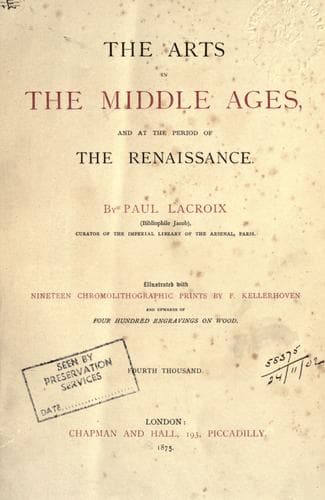
The Arts in the Middle Ages and at the Period of the RenaissanceJacob, P. L.
History
The Arts in the Middle Ages and at the Period of the Renaissance
Jacob, P. L.
Art, Medieval; Art, Renaissance; Middle Ages
THE horse has been described by Buffon as “the noblest conquest made by
man.” Historians, both, sacred and profane, inform us that the conquest
dates from the most remote ages. In the Book of Job we have this
magnificent description:--“Then the Lord said, Hast thou given the horse
strength? hast thou clothed his neck with thunder? Canst thou make him
afraid as a grasshopper? the glory of his nostrils is terrible. He
paweth in the valley, and rejoiceth in his strength: he goeth on to meet
the armed men. He mocketh at fear, and is not affrighted; neither
turneth he back from the sword. The quiver rattleth against him, the
glittering spear and the shield. He swalloweth the ground with
fierceness and rage; neither believeth he that it is the sound of the
trumpet. He saith among the trumpets, Ha, ha; and he smelleth the battle
afar off.” The sacred writer is here referring expressly to the fiery
animal trained for war, and obedient to the master who has trained him.
Xenophon, in his “Treatise on Horsemanship” and his “Instructor of
Cavalry,” and Diodorus in his “Histories,” are among the Greeks who
adduce the most numerous testimonies to the honour in which equestrian
exercises were held. Among the Latins, Virgil, in reference to the
funereal games celebrated by Acestes in honour of Anchises, tells us
that the Roman youth were taught equestrian art as practised by the
Trojans. The horse and chariot races, which took place at the solemn
games in Greece, have always been justly celebrated; as were those which
continued in Rome and in all the great cities of the Roman world until
the fifth or sixth century.
We are disposed to believe that the use of the saddle-horse and the
carriage-horse was introduced about the same time. But it seems that
chariots were rarely mounted by any but chiefs, who fought from that
ambulatory elevation while squires managed the horses.
[Illustration: Fig. 72.--The Carruca, or Pleasure-Carriage, drawn by a
Pair of Horses, dating from the Fifth to the Tenth Century. (Taken from
a MS. of the Ninth Century, in the Royal Library at Brussels.)]
To Cyrus the Great is ascribed the first idea of arming chariots with
scythes, which cut to pieces in every direction those who opposed the
progress of the vehicle, or who were thrown down by the violence of the
shock. The same war-carriages were found among the Gauls; for a king
named Bituitus, having been taken prisoner by the Romans, appeared in
his chariot armed with scythes in the triumphal procession of the
general who had conquered him.
[Illustration: Fig. 73.--Cart drawn by Oxen, end of the Fifteenth
Century. (Taken from the “Chroniques de Hainault,” MS. in the Royal
Library at Brussels.)]
Public-domain text, read in full here on John Shaqi.
Reviews
Reviews
No reviews yet
Be the first to share your thoughts on this work.
Elsewhere in the archive
Join the Discussion
Join the discussion
Sign in to leave a comment or review.
Sign InorCreate an account