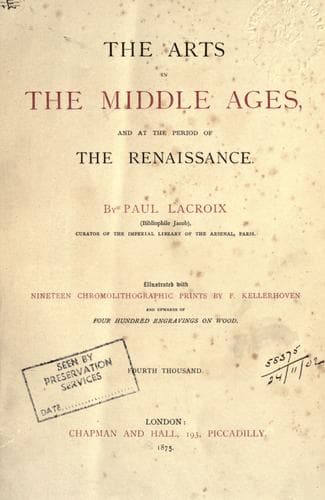
The Arts in the Middle Ages and at the Period of the RenaissanceJacob, P. L.
History
The Arts in the Middle Ages and at the Period of the Renaissance
Jacob, P. L.
Art, Medieval; Art, Renaissance; Middle Ages
Light troops were armed with these guns, and took the name of
_carabins_; from this the weapon was next called _carabine_--a
designation which since then has received quite another meaning.
[Illustration: Fig. 70.--Battle-axe and Pistol of the 16th Century.
(Museum of Artillery, Paris.)]
Then followed the _pistoles_ and the _pistolets_, thus named, it is
said, because they were invented at Pistoia; but, with other
etymologists, we can also believe that they owed the name to the fact of
their bore being of equal diameter with that of the _pistole_, a coin of
the time. The earliest pistols were made with wheels (_à rouet_), and
the barrel did not measure more than a foot in length. Subsequently they
varied in shape and in use; some were made which fired several shots in
succession, and in other cases they attempted to combine a pistol with
the dagger or the battle-axe. (Fig. 70, &c.) This is a notably fine
specimen.
We must not forget to note, in what may be called _les armes de luxe_,
the joint application of the match-holder and the wheel to
highly-finished arms, this combination being available.
The screw-plate _à miquelet_, improved by French experiments, led to the
mechanism called flint-lock (_fusil_). There were also then pistols and
arquebuses with flint-locks, as formerly there had been pistols and
arquebuses with wheels. Subsequently the explanatory became the absolute
term, and the entire weapon was known as _fusil_.
[Illustration: Fig. 71.--Banner of the Sword-cutlers of Angers.]
CARRIAGES AND SADDLERY.
Horsemanship among the Ancients.--The Riding-horse and the
Carriage-horse.--Chariots armed with Scythes.--Vehicles of the
Romans, the Gauls, and the Franks: the Carruca, the Petoritum, the
Cisium, the Plaustrum, the Basterna, the Carpentum.--Different
kinds of Saddle-horses in the Days of Chivalry.--The Spur a
distinctive Sign of Nobility: its Origin.--The Saddle, its Origin
and its Modifications.--The Tilter.--Carriages.--The Mules of
Magistrates.--Corporations of Saddlers and Harness-makers,
Lorimers, Coachmakers, Chapuiseurs, Blazonniers, and
Saddle-coverers.
Public-domain text, read in full here on John Shaqi.
Reviews
Reviews
No reviews yet
Be the first to share your thoughts on this work.
Elsewhere in the archive
Join the Discussion
Join the discussion
Sign in to leave a comment or review.
Sign InorCreate an account