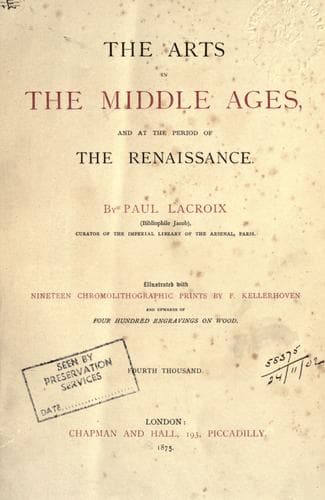
The Arts in the Middle Ages and at the Period of the RenaissanceJacob, P. L.
History
The Arts in the Middle Ages and at the Period of the Renaissance
Jacob, P. L.
Art, Medieval; Art, Renaissance; Middle Ages
Formerly there were in Paris, as appears from numerous documents,
several corporations representing the saddler’s trade. First came the
_selliers-bourreliers_, and the _selliers-lormiers-carrossiers_. The
privileges of the first secured to them specially the manufacture of
saddles and harness (collars and other articles for draught). The second
made also carriages, bridles, reins, &c. Another very ancient
corporation was that of the _lormiers-éperonniers_--“artisans,” says the
Glossary of Jean de Garlande, “whom the military nobles greatly
patronised, because they manufactured silvered and gilt spurs, metal
breastplates for their horses, and well-executed bits.” There were also
_chapuissiers_, who made saddle-bows and pack-frames for the beasts of
burden, which were mostly manufactured of alder-wood.
The _blazenniers_ and _cuireurs_ then covered with leather the packs and
the saddles prepared by the _chapuissiers_; and, finally,
saddle-painters were employed to ornament them, either in compliance
with fashion, which has always been omnipotent in France, or according
to the laws of heraldry, when intended for men of rank for purposes of
state or war.
[Illustration: Fig. 84.--Banner of the Corporation of the Saddlers of
Tonnerre.]
GOLD AND SILVER WORK.
Its Antiquity.--The Trésor de Guarrazar.--The Merovingian and
Carlovingian Periods.--Ecclesiastical Jewellery.--Pre-eminence of
the Byzantine Goldsmiths.--Progress of the Art consequent on the
Crusades.--The Gold and Enamels of Limoges.--Jewellery ceases to be
restricted to Purposes of Religion.--Transparent Enamels.--Jean of
Pisa, Agnolo of Sienna, Ghiberti.--Great Painters and Sculptors
from the Goldsmiths’ Workshops.--Benvenuto Cellini.--The Goldsmiths
of Paris.
In the remarks upon furniture, we were compelled to trespass on the
domain which we now again approach; for, having to trace the history of
secular and religious luxury, we cannot but frequently encounter the
goldsmiths and their splendid works. It will thus happen more than once
that we shall have to indicate briefly certain important facts already
described, in some details, in preceding chapters.
It is known that in old times, even the most remote, the goldsmith’s art
flourished. There is scarcely any ancient narrative which does not
allude to jewels; and every day the discovery of precious objects, found
in ruins and in tombs, still attests the high state of perfection the
art of gold and silver work had attained among races long since extinct.
The Gauls, when under Roman dominion, applied themselves successfully to
the business of the gold-worker. We may again say that the triumph of
the Christian religion, under Constantine the Great, while encouraging
the interior decoration of places of worship, added a fresh impulse to
the development of this beautiful art.
Public-domain text, read in full here on John Shaqi.
Reviews
Reviews
No reviews yet
Be the first to share your thoughts on this work.
Elsewhere in the archive
Join the Discussion
Join the discussion
Sign in to leave a comment or review.
Sign InorCreate an account