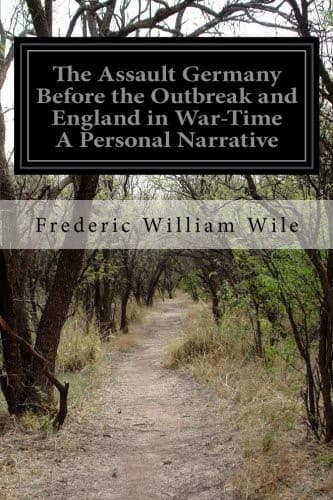
The Assault: Germany Before the Outbreak and England in War-TimeWile, Frederic William
History
The Assault: Germany Before the Outbreak and England in War-Time
Wile, Frederic William
World War, 1914-1918
Shepherd’s Bush envisaged war not as an unmixed evil, but as something
better, somehow, than peace had ever been. It is all woefully at
loggerheads with Norman Angell’s theories of the "devastating economic
influence of war." But the immutable fact is that working-class
Britain, despite the havoc the war has played with trade, incomes and
high finance generally, finds itself, despite even the higher cost of
living, at least on as prosperous a level as at any time in its
contemporary history. It may be a myopic view, but it explains, in my
judgment, much of the proletariat’s amazing apathy toward the crucial
national emergency.
The building of the New England is still in progress. The melting-pot is
full. Years will elapse before the finished product leaves the
crucible. The process of transition, however, has made enormous
strides. Adversity is a wonderful reorganizer. The physiognomy of
things long held unchangeable is altered almost beyond recognition. It
is a better England already, as well as a new one. Above all, Democracy
has not failed in the supreme test. The spectacle of three million men,
uncoerced, responsive and responsible to no law but their own
conscience, marching out to death and glory that England may live, is a
sublime picture, which will blot out and overshadow much of the bungling
and many of the disasters and excrescences of the past.
If I have seemed to dwell with insistence and even cynicism upon
"British calm" amid the thunders, let me here and now subscribe
unqualifiedly to the view that it remains, when all is said and done, a
magnificent achievement second only to the demonstration of Voluntaryism
as a Democracy’s first line of defense. Britannia will continue to rule
the waves mainly because she was calm when they surged about her most
angrily.
CHAPTER XXII
QUO VADIS?
October, 1915. The eighty-third day of the second year of war. A
woman, writing in _The Times_, suggests that England adopt as her
national prayer, "God help us win this war." King George V, emerging at
length from the No Man’s Land of Constitutional Irresponsibility,
appeals, stirringly, "to my people" to save the sinking bark of
Voluntary military service. It is the calm before the Conscription
storm. The Sovereign discourses upon "the grave moment in the struggle"
and calls for "men of all classes to come forward and take their share
in the fight in order that another may not inherit the free Empire which
their ancestors and mine have built." The King hints at "the darkest
moment" which, from time immemorial, "has ever produced in men of our
race the sternest resolve."
Public-domain text, read in full here on John Shaqi.
Reviews
Reviews
No reviews yet
Be the first to share your thoughts on this work.
Elsewhere in the archive
Join the Discussion
Join the discussion
Sign in to leave a comment or review.
Sign InorCreate an account