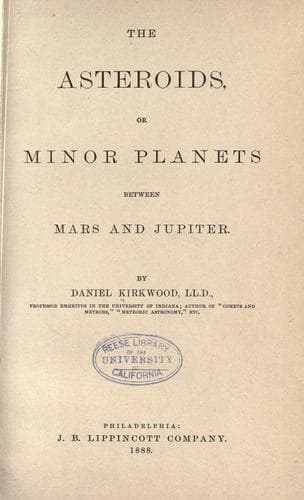
The Asteroids; Or Minor Planets Between Mars and Jupiter.Kirkwood, Daniel
Science
The Asteroids; Or Minor Planets Between Mars and Jupiter.
Kirkwood, Daniel
Asteroids
Before arrangements had been made for the telegraphic transmission
of discoveries between Europe and America, or even between the
observatories of Europe, the same planet was sometimes independently
discovered by different observers. For example, Virginia was found by
Ferguson, at Washington, on October 4, 1857, and by Luther, at Bilk,
fifteen days later. In all cases, however, credit has been given to the
first observer.
Hersilia, the two hundred and sixth of the group, was lost before
sufficient observations were obtained for determining its elements. It
was not rediscovered till December 14, 1884. Menippe, the one hundred
and eighty-eighth, was also lost soon after its discovery in 1878. It
has not been seen for more than nine years, and considerable uncertainty
attaches to its estimated elements.
Of the two hundred and seventy-one members now known (1887), one hundred
and ninety-one have been discovered in Europe, seventy-four in America,
and six in Asia. The years of most successful search, together with the
number discovered in each, were:
Asteroids.
1879 20
1875 17
1868 12
1878 12
And six has been the average yearly number since the commencement of
renewed effort in 1845. All the larger members of the group have,
doubtless, been discovered. It seems not improbable, however, that an
indefinite number of very small bodies belonging to the zone remain to
be found. The process of discovery is becoming more difficult as the
known number increases. The astronomer, for instance, who may discover
number two hundred and seventy-two must know the simultaneous positions
of the two hundred and seventy-one previously detected before he can
decide whether he has picked up a new planet or merely rediscovered an
old one. The numbers discovered in the several months are as follows:
January 13
February 23
March 19
April 35
May 21
June 13
July 14
August 28
September 46
October 28
November 26
December 5
This obvious disparity is readily explained. The weather is favorable
for night watching in April and September; the winter months are too
cold for continuous observations; and the small numbers in June and July
may be referred to the shortness of the nights.
4. Mode of Discovery.
The astronomer who would undertake the search for new asteroids must
supply himself with star-charts extending some considerable distance on
each side of the ecliptic, and containing all telescopic stars down to
the thirteenth or fourteenth magnitude. The detection of a star not
found in the chart of a particular section will indicate its motion, and
hence its planetary character. The construction of such charts has been
a principal object in the labors of Dr. Peters, at Clinton, New York. In
fact, his discovery of minor planets has in most instances been merely
an incidental result of his larger and more important work.
NAMES AND SYMBOLS.
Public-domain text, read in full here on John Shaqi.
Reviews
Reviews
No reviews yet
Be the first to share your thoughts on this work.
Join the Discussion
Join the discussion
Sign in to leave a comment or review.
Sign InorCreate an account