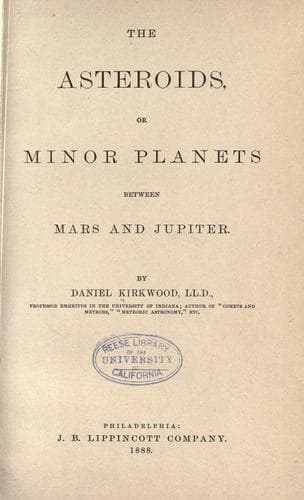
The Asteroids; Or Minor Planets Between Mars and Jupiter.Kirkwood, Daniel
Science
The Asteroids; Or Minor Planets Between Mars and Jupiter.
Kirkwood, Daniel
Asteroids
Ismene | 3.9471 | 2864.3 | 0.1634 | 105 39 | 177 0 | 6 7
153. Hilda | 3.9523 | 2869.9 | 0.1721 | 285 47 | 228 20 | 7 55
-----------------+--------+---------+--------+----------+----------+--------
PART II.
DISCUSSION OF THE FACTS IN TABLE II.
1. Extent of the Zone.
In Table II. the unit of column _a_ is the earth's mean distance from
the sun, or ninety-three million miles. On this scale the breadth of the
zone is 1.8196. Or, if we estimate the breadth from the perihelion of
Æthra (1.612) to the aphelion of Andromache (4.726), it is 3.114,--more
than three times the radius of the earth's orbit. A very remarkable
characteristic of the group is the interlacing or intertwining of
orbits. "One fact," says D'Arrest, "seems above all to confirm the idea
of an intimate relation between all the minor planets; it is, that if
their orbits are figured under the form of material rings, these rings
will be found so entangled that it would be possible, by means of one
among them taken at hazard, to lift up all the rest."[6] Our present
knowledge of this wide and complicated cluster is the result of a vast
amount, not only of observations, but also of mathematical labor. In
view, however, of the perturbations of these bodies by the larger
planets, and especially by Jupiter, it is easy to see that the
discussion of their motions must present a field of investigation
practically boundless.
While the known minor planets were but few in number the theory of
Olbers in regard to their origin seemed highly probable; it has,
however, been completely disproved by more recent discoveries. The
breadth of the zone being now greater than the distance of Mars from the
sun, it is no more probable that the asteroids were produced by the
disruption of a single planet than that Mercury, Venus, the earth, and
Mars originated in a similar manner.
2. The Small Mass of the Asteroids.
In taking a general view of the solar system we cannot fail to be struck
by the remarkable fact that Jupiter, whose mass is much greater than
that of all other planets united, should be immediately succeeded by a
region so nearly destitute of matter as the zone of asteroids. Leverrier
inferred from the motion of Mars's perihelion that the mass of Jupiter
is at least twelve hundred times greater than that of all the planets in
the asteroid ring. The fact is suggestive of Jupiter's dominating energy
in the evolution of the asteroid system. We find also something
analogous among the satellites of Jupiter, Saturn, and Uranus. Jupiter's
third satellite, the largest of the number, is nearly four times greater
than the second. Immediately within the orbit of Titan, the largest
satellite of Saturn, occurs a wide hiatus, and the volume of the next
interior satellite is to that of Titan in the ratio of one to
twenty-one. In the Uranian system the widest interval between adjacent
orbits is just within the orbit of the bright satellite, Titania.
Public-domain text, read in full here on John Shaqi.
Reviews
Reviews
No reviews yet
Be the first to share your thoughts on this work.
Join the Discussion
Join the discussion
Sign in to leave a comment or review.
Sign InorCreate an account