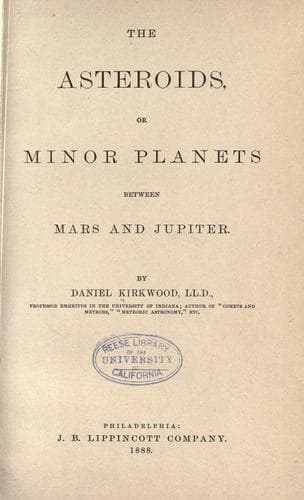
The Asteroids; Or Minor Planets Between Mars and Jupiter.Kirkwood, Daniel
Science
The Asteroids; Or Minor Planets Between Mars and Jupiter.
Kirkwood, Daniel
Asteroids
At the beginning of the seventeenth century but six primary planets and
one satellite were known as members of the solar system. Very few, even
of the learned, had then accepted the theory of Copernicus; in fact,
before the invention of the telescope the evidence in its favor was not
absolutely conclusive. On the 7th of January, 1610, Galileo first saw
the satellites of Jupiter. The bearing of this discovery on the theory
of the universe was sufficiently obvious. Such was the prejudice,
however, against the Copernican system that some of its opponents denied
even the reality of Galileo's discovery. "Those satellites," said a
Tuscan astronomer, "are invisible to the naked eye, and therefore can
exercise no influence on the earth, and therefore would be useless, and
therefore do not exist. Besides, the Jews and other ancient nations, as
well as modern Europeans, have adopted the division of the week into
_seven_ days, and have named them from the seven planets; now, if we
increase the number of planets this whole system falls to the ground."
No other secondary planet was discovered till March 25, 1655, when
Titan, the largest satellite of Saturn, was detected by Huyghens. About
two years later (December 7, 1657) the same astronomer discovered the
true form of Saturn's ring; and before the close of the century
(1671-1684) four more satellites, Japetus, Rhea, Tethys, and Dione, were
added to the Saturnian system by the elder Cassini. Our planetary
system, therefore, as known at the close of the seventeenth century,
consisted of six primary and ten secondary planets.
Nearly a century had elapsed from the date of Cassini's discovery of
Dione, when, on the 13th of March, 1781, Sir William Herschel
enlarged the dimensions of our system by the detection of a
planet--Uranus--exterior to Saturn. A few years later (1787-1794) the
same distinguished observer discovered the first and second satellites
of Saturn, and also the four Uranian satellites. He was the only planet
discoverer of the eighteenth century.
2. Discovery of the First Asteroids.
Public-domain text, read in full here on John Shaqi.
Reviews
Reviews
No reviews yet
Be the first to share your thoughts on this work.
Join the Discussion
Join the discussion
Sign in to leave a comment or review.
Sign InorCreate an account