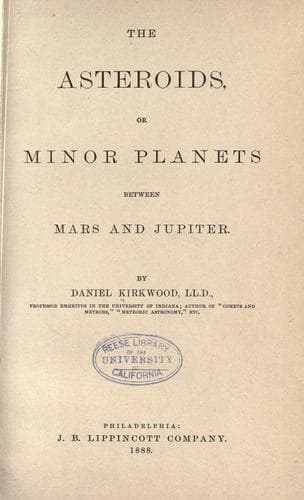
The Asteroids; Or Minor Planets Between Mars and Jupiter. — John Shaqi
The Asteroids; Or Minor Planets Between Mars and Jupiter.Kirkwood, Daniel
Science
The Asteroids; Or Minor Planets Between Mars and Jupiter.
Kirkwood, Daniel
Asteroids
The period of Hilda (153) is more than two and a half times that of
Medusa (149). This is greater than the ratio of Saturn's period to that
of Jupiter. The maximum observed between 2000 and 2100 days corresponds
to the space immediately interior to chasm I. on a previous page, that
between 1300 and 1400 to the space interior to the second, and that
between 1500 and 1700 to the part of the zone within the fourth gap. The
table presents quite numerous instances of approximate equality; in
forty-three cases the periods differing less than twenty-four hours. It
is impossible to say, however, whether any two of these periods are
_exactly_ equal. In cases of a very close approach two asteroids,
notwithstanding their small mass, may exert upon each other quite
sensible perturbations.
11. Origin of the Asteroids.
But four minor planets had been discovered when Laplace issued his last
edition of the "Système du Monde." The author, in his celebrated seventh
note in the second volume of that work, explained the origin of these
bodies by assuming that the primitive ring from which they were formed,
instead of collecting into a single sphere, as in the case of the major
planets, broke up into four distinct masses. But the form and extent of
the cluster as now known, as well as the observed facts bearing on the
constitution of Saturn's ring, seem to require a modification of
Laplace's theory. Throughout the greater part of the interval between
Mars and Jupiter an almost continuous succession of small planetary
masses--not nebulous rings--appears to have been abandoned at the solar
equator. The entire cluster, distributed throughout a space whose outer
radius exceeds the inner by more than two hundred millions of miles,
could not have originated, as supposed by Laplace, in a single nebulous
zone the different parts of which revolved with the same angular
velocity. The following considerations may furnish a suggestion in
regard to the mode in which these bodies were separated from the equator
of the solar nebula.
(_a_) The perihelion distance of Jupiter is 4.950, while the aphelion
distance of Hilda is 4.623. If, therefore, the sun once extended to the
latter, the central attraction of its mass on an equatorial particle was
but five times greater than Jupiter's perihelion influence on the same.
It is easy to see, then, that this "giant planet" would produce enormous
tidal elevations in the solar mass.
(_b_) The centrifugal force would be greatest at the crest of this tidal
wave.
(_c_) Three periods of solar revolution were then about equal to two
periods of Jupiter. The disturbing influence of the planet would
therefore be increased at each conjunction with this protuberance. The
ultimate separation (not of a ring but) of a planetary mass would be the
probable result of these combined and accumulating forces.
12. Variability of Certain Asteroids.
Public-domain text, read in full here on John Shaqi.
Reviews
Reviews
No reviews yet
Be the first to share your thoughts on this work.
Join the Discussion
Join the discussion
Sign in to leave a comment or review.
Sign InorCreate an account