The Asteroids; Or Minor Planets Between Mars and Jupiter. — John Shaqi
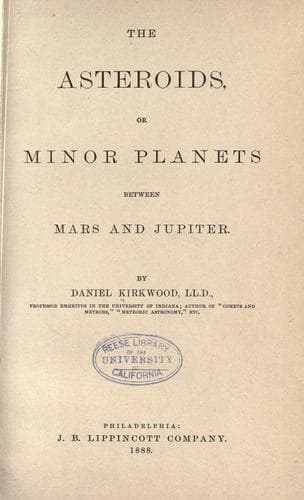
The Asteroids; Or Minor Planets Between Mars and Jupiter.Kirkwood, Daniel
Science
The Asteroids; Or Minor Planets Between Mars and Jupiter.
Kirkwood, Daniel
Asteroids
Before Ceres had been generally adopted by astronomers as the name of
the first asteroid, Laplace had expressed a preference for Juno. This,
however, the discoverer was unwilling to accept. Mr. Harding, like
Laplace, deeming it appropriate to place Juno near Jupiter, selected the
name for the third minor planet, which is accordingly known by this
designation.
Juno is distinguished among the first asteroids by the great
eccentricity of its orbit, amounting to more than 0.25. Its least and
its greatest distances from the sun are therefore to each other very
nearly in the ratio of three to five. The planet consequently receives
nearly three times as much light and heat in perihelion as in aphelion.
It follows, also, that the half of the orbit nearest the sun is
described in about eighteen months, while the remainder, or more distant
half, is not passed over in much less than three years. Schroeter
noticed a variation in the light of Juno, which he supposed to be
produced by an axial rotation in about twenty-seven hours.
The fact that Juno was discovered not far from the point at which the
orbit of Pallas approaches very near that of Ceres, was considered a
strong confirmation of the hypothesis that the asteroids were produced
by the explosion of a large planet; for in case this hypothesis be
founded in truth, it is evident that whatever may have been the forms of
the various orbits assumed by the fragments, they must all return to the
point of separation. In order, therefore, to detect other members of the
group, Dr. Olbers undertook a systematic examination of the two opposite
regions of the heavens through which they must pass. This search was
prosecuted with great industry and perseverance till ultimately crowned
with success. On the 29th of March, 1807, while sweeping over one of
those regions through which the orbits of the known asteroids passed, a
star of the sixth magnitude was observed where none had been seen at
previous examinations. Its planetary character, which was immediately
suspected, was confirmed by observation, its motion being detected on
the very evening of its discovery. This fortunate result afforded the
first instance of the discovery of two primary planets by the same
observer.
The astronomer Gauss having been requested to name the new planet, fixed
upon Vesta, a name universally accepted. Though the brightest of the
asteroids, its apparent diameter is too small to be accurately
determined, and hence its real magnitude is not well ascertained.
Professor Harrington, of Ann Arbor, has estimated the diameter at five
hundred and twenty miles. According to others, however, it does not
exceed three hundred. If the latter be correct, the volume is about
1/20000 that of the earth. It is remarkable that notwithstanding its
diminutive size it may be seen under favorable circumstances by the
naked eye.
Public-domain text, read in full here on John Shaqi.
Reviews
Reviews
No reviews yet
Be the first to share your thoughts on this work.
Join the Discussion
Join the discussion
Sign in to leave a comment or review.
Sign InorCreate an account