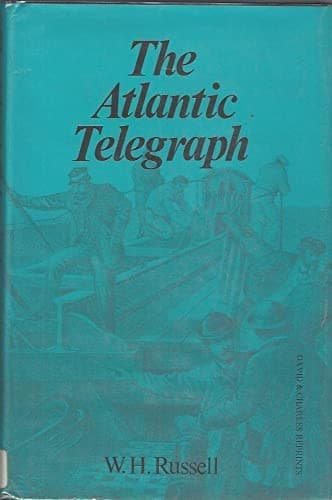
The Atlantic Telegraph (1865)Russell, William Howard, Sir
History
The Atlantic Telegraph (1865)
Russell, William Howard, Sir
Transatlantic cables
Now it may be fairly concluded, from our experience of the “Atlantic
Telegraph Expeditions” in 1857, 1858, and 1865,--That a submarine
telegraph Cable can be laid between Ireland and Newfoundland, because it
was actually done in 1858. That messages can be transmitted through a
Cable so laid, because 271 messages were sent from Newfoundland to
Valentia, and 129 messages from Valentia to Newfoundland, in 1858. That
the insulation of a Cable increases very much after its submersion in
the cold deep water of the Atlantic, and that its conducting power is
considerably improved thereby. That the steamship Great Eastern, from
her size and constant steadiness, and from the control over her afforded
by the joint use of paddle and screw, renders it possible and safe for
her to lay an Atlantic Cable without regard to the weather. That the
egress of a Cable in the course of being laid from the Great Eastern may
be safely stopped on the appearance of a fault, and with strong tackle
and good hauling-in machinery, the fault may be lifted from a depth of
over 2000 fathoms, and cut out on board the ship, and the Cable
respliced and laid in perfect condition. That in a depth of two miles a
Cable can be caught at the bottom, because four attempts were made to
grapple the Cable in 1865, and in three of them the Cable was caught by
the grapnel.
The paying-out machinery, constructed by Messrs. Canning and Clifford,
and used on board the Great Eastern in 1865, worked perfectly, and can
be confidently relied on for laying Cables across the Atlantic. With the
improved telegraphic instruments, for long submarine lines, of Professor
W. Thomson and Mr. Varley, a speed of more than eight words per minute
can be obtained through such a circuit as the Atlantic Cable of 1865,
between Ireland and Newfoundland; as the amount of slack actually
payed-out did not exceed 14 per cent., which would have made the total
Cable laid between Valentia and Heart’s Content less than 1,900 miles.
The Cable of 1865, though capable of bearing a strain of 7 tons, did not
experience more than 14 cwt. in being payed-out into the deepest water
of the Atlantic between Ireland and Newfoundland.
There is no difficulty in mooring buoys in the deep water of the
Atlantic between Ireland and Newfoundland; a buoy, even when moored by a
piece of the Atlantic Cable itself which had been previously lifted from
a depth of over 2000 fathoms, has ridden out a gale.
More than four miles of the Atlantic Cable have been recovered from a
depth of over two miles, and the insulation of the gutta-percha-covered
wire was in no way whatever impaired, either by the depth of water or
the strains to which it had been subjected by lifting and passing
through the hauling-in apparatus.
Public-domain text, read in full here on John Shaqi.
Reviews
Reviews
No reviews yet
Be the first to share your thoughts on this work.
Elsewhere in the archive
Join the Discussion
Join the discussion
Sign in to leave a comment or review.
Sign InorCreate an account