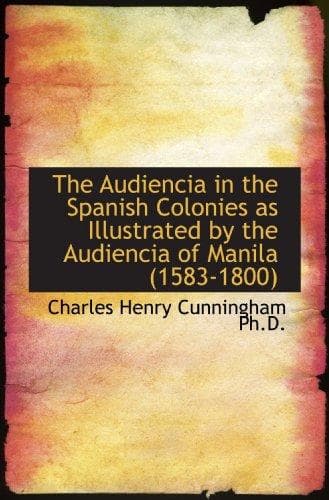
The Audiencia in the Spanish Colonies: As illustrated by the Audiencia of Manila (1583-1800)Cunningham, Charles Henry
History
The Audiencia in the Spanish Colonies: As illustrated by the Audiencia of Manila (1583-1800)
Cunningham, Charles Henry
Philippines -- History -- 1521-1812; Spain -- Colonies -- Administration
Indeed, it may be said that the various experiments made by the
monarchs during the seventeenth and early eighteenth centuries for
the purpose of perfecting a system whereby the governorship could
be satisfactorily filled ad interim had failed to demonstrate or
develop any authority capable of maintaining harmony or decent
government. Co-operation among the authorities of the colony was
practically unknown. The royal disapproval was passed upon practically
all the official acts of these interim administrations. The thirst
for personal glory, and the desire for private gain invariably
induced some official who was stronger than his contemporaries to
assume control of affairs; thus the government of the colony was made
repeatedly to subserve personal ends, and civil and political life
was characterized by its strife and discord. The probabilities that
the temporary administration of the audiencia would not be entirely
successful had been recognized from the beginning, and in order to
guard against its misrule the king had authorized the appointment of
a temporary governor by the Viceroy of New Spain. It was unavoidable,
however, that the audiencia should govern until the arrival of this
official. For a time the alternative was tried of allowing the maestre
de campo to assume the military command, but this resulted in such an
incompetent rule that the former prerogatives of the audiencia were
restored. Whether the audiencia was capable of governing successfully
or not, it certainly had the power to make or mar the government of
any other person or authority, whether he was regularly appointed by
the king, or chosen temporarily by the viceroy.
The church, as represented by a succession of triumphant archbishops,
had exercised the preponderance of power and authority throughout the
forty years of strife, ending with the death of Governor Bustamante. We
need not be concerned here with the various struggles and disagreements
with governors and audiencias, but the fact remains that the church
was the only institution existing during this period which was able to
present a solid and united front to its enemies, or which manifested
any symptoms of power, unity or royal approbation. The culmination
of ecclesiastical power was virtually reached on October 11, 1719,
when Governor Bustamante was murdered by emissaries of the church
and Fray Francisco de la Cuesta, Archbishop of Manila, assumed the
vacant governorship.
Public-domain text, read in full here on John Shaqi.
Reviews
Reviews
No reviews yet
Be the first to share your thoughts on this work.
Elsewhere in the archive
Join the Discussion
Join the discussion
Sign in to leave a comment or review.
Sign InorCreate an account