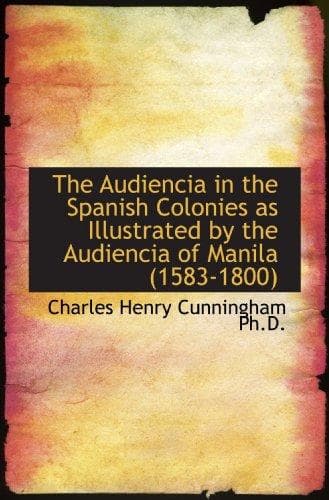
The Audiencia in the Spanish Colonies: As illustrated by the Audiencia of Manila (1583-1800)Cunningham, Charles Henry
History
The Audiencia in the Spanish Colonies: As illustrated by the Audiencia of Manila (1583-1800)
Cunningham, Charles Henry
Philippines -- History -- 1521-1812; Spain -- Colonies -- Administration
By the Royal Instruction of Regents of 1776, the regent was authorized
to act as president of the audiencia during the absence of the
governor, and in case there were no regent, the senior magistrate of
the audiencia was to take his place. [685] This law was confirmed
by the cédula of August 2, 1789, which ordered that viceroys and
presidents, on going outside of their capitals, "should assign to
the regents the faculties for the dispatch of the most important
and immediate affairs." [686] A subsequent law, dated July 30, 1779,
stated that "these important and immediate affairs" did not include
"the duties and functions of the captain-general." Again, the royal
order of October 23, 1806, [687] commanded that the audiencia should
in no case take control of the government when there was a vacancy,
but that the name of the temporary governor should be contained in
an envelope which was to be opened on the death of the governor, or
on his absence from the district. In case provision had not been made
in this way, it was ordered that the government should be taken over
by the ranking military officer of the colony, if he were higher than
the grade of colonel; if not, the regent or decano should be temporary
president, governor and captain-general, without ceding the exercise
of any of the functions of this office to the audiencia. [688] This
law was suspended by the royal order of July 12, 1812, and by the
decree of November 2, 1834, which ordered that the segundo cabo, or
lieutenant-commander of the king's forces should succeed the governor
and captain-general. [689] It is important to note that these laws
were applicable throughout the Spanish colonial empire. Subsequent
vacancies in the Philippines were filled by military men, and the
audiencia refrained from interference with the government.
Considering the question in its broadest phases, it cannot be said that
the audiencia administered the ad interim rule with a great degree of
success. This method of filling vacancies in the governorship failed
for a number of reasons. Owing to the divided composition of the
tribunal, the rivalry and personal jealousy of the magistrates and
the perpetual quarrels and struggles which arose as a consequence,
the periods of its rule became wild scrambles for power in which
the strongest survived and reaped all the benefits of office. By
their example, the oidores stimulated others to wrong-doing, and in
their efforts to secure advantages for themselves they oppressed the
residents, Spanish and native, with the burden of their misrule. They
did not scruple to indulge in dishonest practices whenever occasion
offered; indeed, they went out of their way to seek such opportunities.
Public-domain text, read in full here on John Shaqi.
The Audiencia in the Spanish Colonies: As illustrated by the Audiencia of Manila (1583-1800) — John Shaqi
Reviews
Reviews
No reviews yet
Be the first to share your thoughts on this work.
Elsewhere in the archive
Join the Discussion
Join the discussion
Sign in to leave a comment or review.
Sign InorCreate an account