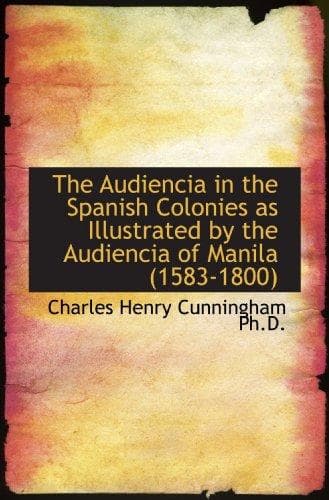
The Audiencia in the Spanish Colonies: As illustrated by the Audiencia of Manila (1583-1800)Cunningham, Charles Henry
History
The Audiencia in the Spanish Colonies: As illustrated by the Audiencia of Manila (1583-1800)
Cunningham, Charles Henry
Philippines -- History -- 1521-1812; Spain -- Colonies -- Administration
Perhaps the gravest defect of the rule of the audiencia lay in
its failure as an executive, owing to the divided character of
its composition. There was much jealousy, but neither unity nor
centralized responsibility. In their governmental capacity the oidores
frequently enacted measures and made recommendations of a statesmanlike
character, although they did not always succeed in enforcing them. The
magistrates were neither experienced legislators nor trained soldiers,
and the latter defect seems to have been a cause of considerable
dissatisfaction, especially among the military classes. These were
naturally jealous of an assumption of military power by lawyers, whose
commands they refused to obey. Nevertheless it must be conceded that
such individual oidores as Morga, Alcaraz, Almansa and Anda acquitted
themselves of their military duties with great credit when called upon.
The reform which gave the government to the churchmen was designed to
obviate the defects expressed above. It was believed that a prelate
would not be open to so many ventures of a questionable and mainly
commercial character. Moreover, the archbishops in Mexico and elsewhere
had fulfilled the duties of the executive on former occasions with
a fair degree of success. The church was the most powerful, highly
centralized and unified institution in the Philippines at the time
when both the audiencia and the governorship were weakest. The
ecclesiastical authority had repeatedly triumphed over the civil
government, and the former gave promise of being able to control
matters more effectively in the future than the audiencia had done in
the past. The rule of the churchmen did not remedy matters, however,
except that it produced harmony through the exercise of force. During
the rule of the archbishops, with the exception of that of Rojo, the
audiencia was so completely dominated by the ecclesiastical power that
the tribunal could scarcely be considered a factor in the government.
Public-domain text, read in full here on John Shaqi.
Reviews
Reviews
No reviews yet
Be the first to share your thoughts on this work.
Elsewhere in the archive
Join the Discussion
Join the discussion
Sign in to leave a comment or review.
Sign InorCreate an account