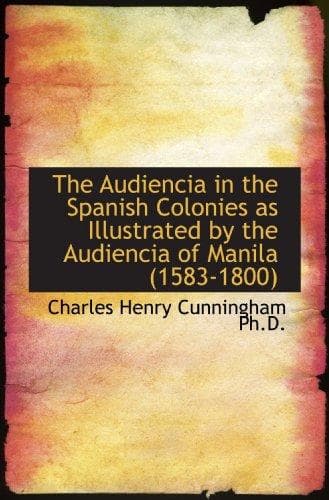
The Audiencia in the Spanish Colonies: As illustrated by the Audiencia of Manila (1583-1800)Cunningham, Charles Henry
History
The Audiencia in the Spanish Colonies: As illustrated by the Audiencia of Manila (1583-1800)
Cunningham, Charles Henry
Philippines -- History -- 1521-1812; Spain -- Colonies -- Administration
There were various defects in the rule of the ecclesiastics. Of these,
perhaps the most prominent was their failure to meet the military
requirements of the position. Because of the natural incongruity
existing between ecclesiastical and military duties, they were
obliged to delegate the command of the troops to military leaders,
who thus exercised an influence never realized by them during the
rule of the audiencia. Archbishop Rojo was unwilling to trust the
problem of defense to any other person, though unable to cope with
the situation himself. Hence Anda forced his way to the front because
he was fitted to command and Rojo was not. As administrators and
executives the prelates were as efficient as any others, but they were
never able to reconcile successfully the opposition of the civil,
political, and commercial elements, who were displeased with the
rule of an ecclesiastic. Surprising as it may seem, the government
of a prelate was usually most unsatisfactory to the churchmen and
religious authorities. If the prelate-governor were a friar, his rule
was resented by the members of all the rival orders. If he were a
secular priest, he was opposed by the friars of all the orders.
The failure of Rojo was enough to condemn the practice of permitting
ecclesiastics to assume the government, but aside from that, there was
a more significant and fundamental reason. The increasing political
authority of the church at that time, both in the colonies and in the
mother country, its widespread and almost irresistible dominance over
temporal affairs, demanded a radical change of policy whereby this
dangerous ecclesiastical power could be checked. The rule of Anda,
though technically based on that law which gave the succession to
the tribunal, was not a typical instance of the government of the
audiencia, nor did that period present all the features of such
a rule. The influence of the audiencia as a body was practically
nil. Anda governed because he was a strong man, not because he was
sole oidor or because he was lieutenant-governor. His government was
virtually a dictatorship, based on military power, but, nevertheless,
just and benevolent. His extra-judicial actions met with the king's
approval, because they were efficient.
Public-domain text, read in full here on John Shaqi.
Reviews
Reviews
No reviews yet
Be the first to share your thoughts on this work.
Elsewhere in the archive
Join the Discussion
Join the discussion
Sign in to leave a comment or review.
Sign InorCreate an account