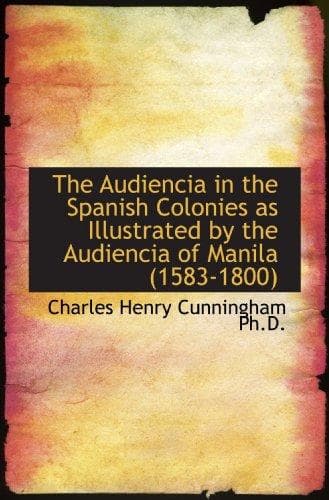
The Audiencia in the Spanish Colonies: As illustrated by the Audiencia of Manila (1583-1800) — John Shaqi
The Audiencia in the Spanish Colonies: As illustrated by the Audiencia of Manila (1583-1800)Cunningham, Charles Henry
History
The Audiencia in the Spanish Colonies: As illustrated by the Audiencia of Manila (1583-1800)
Cunningham, Charles Henry
Philippines -- History -- 1521-1812; Spain -- Colonies -- Administration
On the occasion of Ronquillo's death in 1583, the bishop called
attention to the straits into which the colony had fallen as a
result of the tyrannical methods of the deceased governor. [60] He
described Ronquillo's efforts to prevent residents from appealing to
the audiencia and viceroy of New Spain. He stated that the Indians
had been unjustly treated by the encomenderos and alcaldes mayores,
for when appeals had been made to the governor, the latter, on a
plea of being too busy to occupy himself with such minute details,
had ordered the alcaldes mayores to settle the questions at issue
without disturbing him. Ronquillo was said to have engaged extensively
in commerce, monopolizing the ships to the exclusion of the merchants,
and forcing large loans from the officials and residents, who did not
dare to refuse him, lest all their privileges be taken from them. He
had established private encomiendas in nearly every town in Luzon,
appropriating the income therefrom, instead of turning the proceeds
into the royal treasury. [61] This the prelate conceded to be in
accordance with the conditions of the governor's appointment, but
it was nevertheless unjust, as the privilege of holding encomiendas
was denied to other officials, and the treasury of the colony was in
need of the revenue which had been daily enriching the governor. The
bishop accused the governor of seizing Indians, placing them en
encomienda wherever and whenever he found them, irrespective of
whether they were already free, or whether they belonged on other
encomiendas. These acts, he said, had caused the Indians to be
dissatisfied and rebellious, and he evidently was of the opinion that
a revolt was impending when he penned this memorial. "Many times I
have prayed," he wrote, "that God should close the natives' eyes
in order that they may not see the weakness and the little power
with which we might resist them in case they should arise to put
down these evils." The bishop closed this memorial with a vigorous
protest against the continuance of the hereditary principle in the
succession of governors in the Philippines. He made the general
recommendation that in the future governors should be appointed by
the king, with a view to securing men of administrative and executive
ability. He brought forth strenuous objections to the accession of
the ex-governor's nephew. Diego Ronquillo de Peñalosa, who was not
fitted to occupy the post of governor. If the latter assumed the
government, the bishop could see nothing in store for the colony but
a continuation of the evil days which had been extant throughout the
administration of the elder Ronquillo, "who had spent all his time
in gathering wealth for himself by means of trade, shutting his eyes
and ears to those who asked justice of him." Salazar expressed the
opinion that "had Gonzalo Ronquillo de Peñalosa spent as much of his
time in making conquests and discoveries as he had in making packages
Public-domain text, read in full here on John Shaqi.
Reviews
Reviews
No reviews yet
Be the first to share your thoughts on this work.
Join the Discussion
Join the discussion
Sign in to leave a comment or review.
Sign InorCreate an account