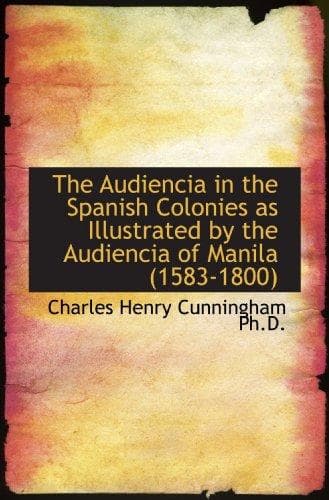
The Audiencia in the Spanish Colonies: As illustrated by the Audiencia of Manila (1583-1800) — John Shaqi
The Audiencia in the Spanish Colonies: As illustrated by the Audiencia of Manila (1583-1800)Cunningham, Charles Henry
History
The Audiencia in the Spanish Colonies: As illustrated by the Audiencia of Manila (1583-1800)
Cunningham, Charles Henry
Philippines -- History -- 1521-1812; Spain -- Colonies -- Administration
This memorial shows that the oidores considered it to be their
duty to inform the court fully as to the part which the audiencia
played in this affair. The matter at hand constituted a question
of disobedience of the law, and the Audiencia of Manila had done
what it could to enforce it. The tribunal had assumed a role quite
as important as that of the governor. The episode shows also that
the audiencia was consulted by the governor in this matter, which
was purely governmental. It would not be unfair to suggest that a
potential factor in stimulating the oidores and merchants of Manila
to prevent the voyage of Pedro Unamanú or the Portuguese to China for
trading purposes must have been the desire to safeguard the Spanish
interests in the Chinese trade, and particularly those of Manila,
which were the sole reliance of the colony. It was essential that
this commerce should be prevented from falling into the hands of
other individuals or nations.
This memorial also dealt with ecclesiastical affairs. In it was
set forth the audiencia's arguments in certain contentions which
the tribunal had had with the bishop, illustrating the fact that
the audiencia was opposed not only by the governor but also by the
ecclesiastical authorities. It appears that the king had formerly
granted to the church courts a large share of temporal jurisdiction
in the Islands. This former concession now stood in the way of the
royal prerogative and caused endless conflicts between the civil and
ecclesiastical judges. The audiencia took the ground that by virtue of
its own establishment the authority of the church courts over civil
matters was at an end. This the prelate declined to admit. Attention
was also directed by the audiencia to the opposition which Bishop
Salazar had manifested toward the claims advanced by the civil
government for extending its jurisdiction over all the non-Christian
tribes, the bishop alleging that Pope Alexander VI had ceded authority
only over such Indians as had been christianized. [82]
In truth, the bishop had found after two years of conflict that the
presence of the audiencia had not entirely solved the problems of
administration, but, on the contrary, had increased the complexity
of many of them. He had differed seriously with the oidores on
several occasions. The ministers had opposed him not only in the
larger questions of government and ecclesiastical administration,
but in matters of ceremony as well. This was more than the prelate
could endure. He appealed some of these disputes to the governor
and that official, after having neglected these matters for a long
period, finally referred them to the audiencia, which promptly made
the settlements in its own favor. [83]
Public-domain text, read in full here on John Shaqi.
Reviews
Reviews
No reviews yet
Be the first to share your thoughts on this work.
Join the Discussion
Join the discussion
Sign in to leave a comment or review.
Sign InorCreate an account