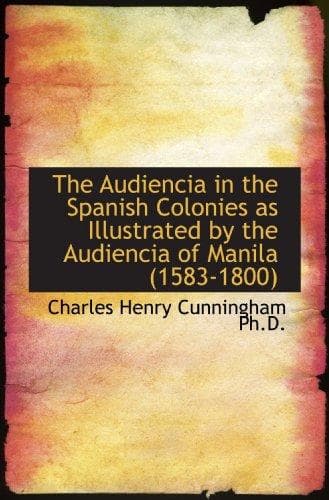
The Audiencia in the Spanish Colonies: As illustrated by the Audiencia of Manila (1583-1800) — John Shaqi
The Audiencia in the Spanish Colonies: As illustrated by the Audiencia of Manila (1583-1800)Cunningham, Charles Henry
History
The Audiencia in the Spanish Colonies: As illustrated by the Audiencia of Manila (1583-1800)
Cunningham, Charles Henry
Philippines -- History -- 1521-1812; Spain -- Colonies -- Administration
The audiencia itself wrote to the Council at the same time: "There
has been in this tribunal, between the oidores and the president,
continual misunderstandings as to jurisdiction, which we have decided
to submit to your Majesty to ascertain whether precedence in these
matters belongs to the president or to the oidores." The Manila cabildo
recommended the re-establishment of the governorship with centralized
authority: the power to grant titles, offices and encomiendas, with
exclusive authority over the latter. This would include the power of
appointing encomenderos in the name of the king. The recommendation
was made by the cabildo that consultative authority in matters of
government should be conferred on the ecclesiastical and military
officials. It was also suggested that a defender of the Indians should
be appointed other than the fiscal, for the latter, by nature of
his office, was their prosecutor rather than their defender. It was
the current opinion, this memorial went on to state, that the local
prelate should be restored to his former place as defender of the
Indians, and that he should have authority to dispossess encomenderos,
if necessity for such action arose.
It has already been stated that Oidor Dávalos was the only official
of importance who would not join in these representations. He believed
that the audiencia was necessary to the prosperity of the colony, and
that, if properly controlled, it would prove beneficial. He believed,
moreover, that the governor was the chief element of discord in the
colony, and that his influence had rendered inefficacious the efforts
of the audiencia to keep peace and to enforce the laws. In a letter
to the king, [87] just a year before the memorial described above,
Dávalos had represented Governor Santiago de Vera as a schemer,
aiming to get absolute control of the government. De Vera, he said,
had gone so far as to influence the bishop and clergy to recommend,
against their better judgment, the abolition of the audiencia. The
governor realized that the tribunal was the one obstacle in the way of
the fulfillment of his designs and had used every possible means to
discredit and humiliate the audiencia and its magistrates. Dávalos
asserted that the appeal of cases to Mexico would inflict great
inconvenience on the people of Manila. He renewed the argument that
Spain should have some sovereign body at that great distance from
the mother country. He enlarged on the future possibilities of the
conquest and rule of the entire Orient by Spain, pointing out the
value of the Philippines as a base of operations. It was, therefore,
of the greatest importance that the Islands should be provided with
the proper sort of government.
Public-domain text, read in full here on John Shaqi.
Reviews
Reviews
No reviews yet
Be the first to share your thoughts on this work.
Join the Discussion
Join the discussion
Sign in to leave a comment or review.
Sign InorCreate an account