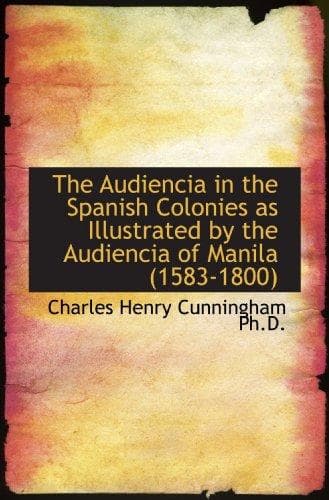
The Audiencia in the Spanish Colonies: As illustrated by the Audiencia of Manila (1583-1800)Cunningham, Charles Henry
History
The Audiencia in the Spanish Colonies: As illustrated by the Audiencia of Manila (1583-1800)
Cunningham, Charles Henry
Philippines -- History -- 1521-1812; Spain -- Colonies -- Administration
A survey of the Spanish colonial system or a study of the government
of any one colony will reveal the fact that political life and
power there were vested chiefly in three institutions. Upon
these the peace, prosperity and security of each colony largely
depended. These institutions were the audiencia, the office of viceroy,
or captain-general, and the church. By means of the two former the
royal interests in the colony were represented, and through the latter
one of the chief aims of Spain's colonial system was effected, namely,
the conversion of infidels and the subsequent care of their souls. The
church added to its own power in various ways. No study of Spanish
colonial institutions would be complete which failed to consider the
church as a political power. It is to a consideration of these three
chief factors of colonial government, and their interrelation, that
this study will be dedicated. After a review of the circumstances
surrounding the establishment of the Audiencia of Manila, we shall
devote ourselves to a detailed study of the audiencia itself. We
shall first notice the audiencia's judicial functions as a court of
ordinary justice and secondarily as a court of residencia. The second
part of this section will be concerned with the semi-judicial and
administrative functions of the audiencia.
The title of captain-general was primarily of military significance,
and it was exercised alike by viceroys and governors; the official
designation of the former being "my viceroy and captain-general"
and that of the latter being "my governor and captain-general." Not
all governors were captains-general.
The viceroys in the larger divisions and the captains-general in the
smaller ones represented the king as head of the church and state
in their several districts. Because these officials were so powerful
and their duties so multitudinous, they came into contact with every
department of the government. The audiencias came into relation with
these officials most frequently. It is therefore necessary to study
the governor and captain-general first from the viewpoint of his
position as chief executive of the colony and as representative of
the king. The frequency of their relations and the identity of their
spheres of authority suggest that we give attention to the conflicts
of jurisdiction of the governor and audiencia; finally, we shall take
note of the occasions on which the audiencia assumed the government
on the event of a vacancy, noticing the laws authorizing such action
and the principles underlying them.
Public-domain text, read in full here on John Shaqi.
Reviews
Reviews
No reviews yet
Be the first to share your thoughts on this work.
Join the Discussion
Join the discussion
Sign in to leave a comment or review.
Sign InorCreate an account