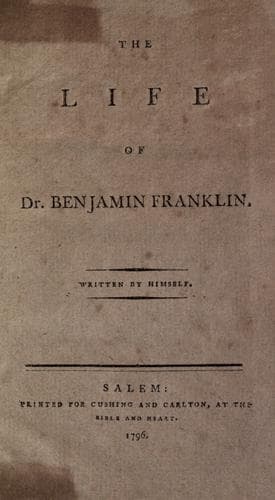
The Autobiography of Benjamin FranklinFranklin, Benjamin
ReligionComparative
The Autobiography of Benjamin Franklin
Franklin, Benjamin
Franklin, Benjamin, 1706-1790; Statesmen -- United States -- Biography
We continu'd there near three months; and by that time I could reckon
among my acquired friends, Judge Allen, Samuel Bustill, the secretary
of the Province, Isaac Pearson, Joseph Cooper, and several of the
Smiths, members of Assembly, and Isaac Decow, the surveyor-general. The
latter was a shrewd, sagacious old man, who told me that he began for
himself, when young, by wheeling clay for the brick-makers, learned to
write after he was of age, carri'd the chain for surveyors, who taught
him surveying, and he had now by his industry, acquir'd a good estate;
and says he, "I foresee that you will soon work this man out of
business, and make a fortune in it at Philadelphia." He had not then
the least intimation of my intention to set up there or anywhere.
These friends were afterwards of great use to me, as I occasionally was
to some of them. They all continued their regard for me as long as
they lived.
Before I enter upon my public appearance in business, it may be well to
let you know the then state of my mind with regard to my principles and
morals, that you may see how far those influenc'd the future events of
my life. My parents had early given me religious impressions, and
brought me through my childhood piously in the Dissenting way. But I
was scarce fifteen, when, after doubting by turns of several points, as
I found them disputed in the different books I read, I began to doubt
of Revelation itself. Some books against Deism fell into my hands;
they were said to be the substance of sermons preached at Boyle's
Lectures. It happened that they wrought an effect on me quite contrary
to what was intended by them; for the arguments of the Deists, which
were quoted to be refuted, appeared to me much stronger than the
refutations; in short, I soon became a thorough Deist. My arguments
perverted some others, particularly Collins and Ralph; but, each of
them having afterwards wrong'd me greatly without the least
compunction, and recollecting Keith's conduct towards me (who was
another freethinker), and my own towards Vernon and Miss Read, which at
times gave me great trouble, I began to suspect that this doctrine,
tho' it might be true, was not very useful. My London pamphlet, which
had for its motto these lines of Dryden:
"Whatever is, is right. Though purblind man
Sees but a part o' the chain, the nearest link:
His eyes not carrying to the equal beam,
That poises all above;"
and from the attributes of God, his infinite wisdom, goodness and
power, concluded that nothing could possibly be wrong in the world, and
that vice and virtue were empty distinctions, no such things existing,
appear'd now not so clever a performance as I once thought it; and I
doubted whether some error had not insinuated itself unperceiv'd into
my argument, so as to infect all that follow'd, as is common in
metaphysical reasonings.
Public-domain text, read in full here on John Shaqi.
Reviews
Reviews
No reviews yet
Be the first to share your thoughts on this work.
Join the Discussion
Join the discussion
Sign in to leave a comment or review.
Sign InorCreate an account