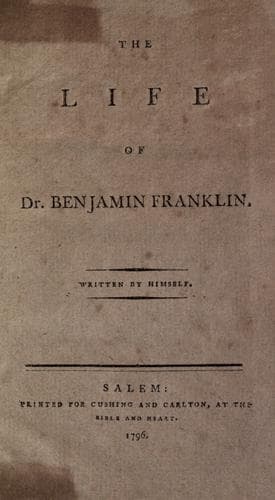
The Autobiography of Benjamin FranklinFranklin, Benjamin
ReligionComparative
The Autobiography of Benjamin Franklin
Franklin, Benjamin
Franklin, Benjamin, 1706-1790; Statesmen -- United States -- Biography
Thus the matter rested for some time, when I said to my partner,
"Perhaps your father is dissatisfied at the part you have undertaken in
this affair of ours, and is unwilling to advance for you and me what he
would for you alone. If that is the case, tell me, and I will resign
the whole to you, and go about my business." "No," said he, "my father
has really been disappointed, and is really unable; and I am unwilling
to distress him farther. I see this is a business I am not fit for. I
was bred a farmer, and it was a folly in me to come to town, and put
myself, at thirty years of age, an apprentice to learn a new trade.
Many of our Welsh people are going to settle in North Carolina, where
land is cheap. I am inclin'd to go with them, and follow my old
employment. You may find friends to assist you. If you will take the
debts of the company upon you; return to my father the hundred pound he
has advanced; pay my little personal debts, and give me thirty pounds
and a new saddle, I will relinquish the partnership, and leave the
whole in your hands." I agreed to this proposal: it was drawn up in
writing, sign'd, and seal'd immediately. I gave him what he demanded,
and he went soon after to Carolina, from whence he sent me next year
two long letters, containing the best account that had been given of
that country, the climate, the soil, husbandry, etc., for in those
matters he was very judicious. I printed them in the papers, and they
gave great satisfaction to the publick.
As soon as he was gone, I recurr'd to my two friends; and because I
would not give an unkind preference to either, I took half of what each
had offered and I wanted of one, and half of the other; paid off the
company's debts, and went on with the business in my own name,
advertising that the partnership was dissolved. I think this was in or
about the year 1729.
About this time there was a cry among the people for more paper money,
only fifteen thousand pounds being extant in the province, and that
soon to be sunk. The wealthy inhabitants oppos'd any addition, being
against all paper currency, from an apprehension that it would
depreciate, as it had done in New England, to the prejudice of all
creditors. We had discuss'd this point in our Junto, where I was on
the side of an addition, being persuaded that the first small sum
struck in 1723 had done much good by increasing the trade, employment,
and number of inhabitants in the province, since I now saw all the old
houses inhabited, and many new ones building; whereas I remembered
well, that when I first walk'd about the streets of Philadelphia,
eating my roll, I saw most of the houses in Walnut-street, between
Second and Front streets, with bills on their doors, "To be let"; and
many likewise in Chestnut-street and other streets, which made me then
think the inhabitants of the city were deserting it one after another.
Public-domain text, read in full here on John Shaqi.
Reviews
Reviews
No reviews yet
Be the first to share your thoughts on this work.
Join the Discussion
Join the discussion
Sign in to leave a comment or review.
Sign InorCreate an account