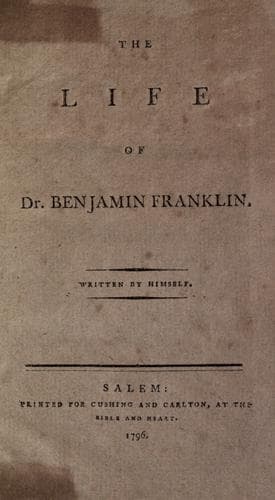
The Autobiography of Benjamin FranklinFranklin, Benjamin
ReligionComparative
The Autobiography of Benjamin Franklin
Franklin, Benjamin
Franklin, Benjamin, 1706-1790; Statesmen -- United States -- Biography
In this piece it was my design to explain and enforce this doctrine,
that vicious actions are not hurtful because they are forbidden, but
forbidden because they are hurtful, the nature of man alone considered;
that it was, therefore, every one's interest to be virtuous who wish'd
to be happy even in this world; and I should, from this circumstance
(there being always in the world a number of rich merchants, nobility,
states, and princes, who have need of honest instruments for the
management of their affairs, and such being so rare), have endeavored
to convince young persons that no qualities were so likely to make a
poor man's fortune as those of probity and integrity.
My list of virtues contain'd at first but twelve; but a Quaker friend
having kindly informed me that I was generally thought proud; that my
pride show'd itself frequently in conversation; that I was not content
with being in the right when discussing any point, but was overbearing,
and rather insolent, of which he convinc'd me by mentioning several
instances; I determined endeavouring to cure myself, if I could, of
this vice or folly among the rest, and I added Humility to my list,
giving an extensive meaning to the word.
I cannot boast of much success in acquiring the reality of this virtue,
but I had a good deal with regard to the appearance of it. I made it a
rule to forbear all direct contradiction to the sentiments of others,
and all positive assertion of my own. I even forbid myself, agreeably
to the old laws of our Junto, the use of every word or expression in
the language that imported a fix'd opinion, such as certainly,
undoubtedly, etc., and I adopted, instead of them, I conceive, I
apprehend, or I imagine a thing to be so or so; or it so appears to me
at present. When another asserted something that I thought an error, I
deny'd myself the pleasure of contradicting him abruptly, and of
showing immediately some absurdity in his proposition; and in answering
I began by observing that in certain cases or circumstances his opinion
would be right, but in the present case there appear'd or seem'd to me
some difference, etc. I soon found the advantage of this change in my
manner; the conversations I engag'd in went on more pleasantly. The
modest way in which I propos'd my opinions procur'd them a readier
reception and less contradiction; I had less mortification when I was
found to be in the wrong, and I more easily prevail'd with others to
give up their mistakes and join with me when I happened to be in the
right.
Public-domain text, read in full here on John Shaqi.
Reviews
Reviews
No reviews yet
Be the first to share your thoughts on this work.
Elsewhere in the archive
Join the Discussion
Join the discussion
Sign in to leave a comment or review.
Sign InorCreate an account