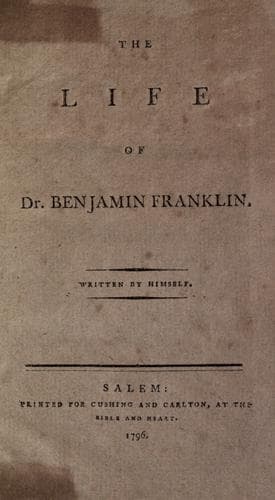
The Autobiography of Benjamin FranklinFranklin, Benjamin
ReligionComparative
The Autobiography of Benjamin Franklin
Franklin, Benjamin
Franklin, Benjamin, 1706-1790; Statesmen -- United States -- Biography
And this mode, which I at first put on with some violence to natural
inclination, became at length so easy, and so habitual to me, that
perhaps for these fifty years past no one has ever heard a dogmatical
expression escape me. And to this habit (after my character of
integrity) I think it principally owing that I had early so much weight
with my fellow-citizens when I proposed new institutions, or
alterations in the old, and so much influence in public councils when I
became a member; for I was but a bad speaker, never eloquent, subject
to much hesitation in my choice of words, hardly correct in language,
and yet I generally carried my points.
In reality, there is, perhaps, no one of our natural passions so hard
to subdue as pride. Disguise it, struggle with it, beat it down,
stifle it, mortify it as much as one pleases, it is still alive, and
will every now and then peep out and show itself; you will see it,
perhaps, often in this history; for, even if I could conceive that I
had compleatly overcome it, I should probably be proud of my humility.
[Thus far written at Passy, 1784.]
["I am now about to write at home, August, 1788, but can not have the
help expected from my papers, many of them being lost in the war. I
have, however, found the following."][8]
[8]This is a marginal memorandum.—B.
HAVING mentioned a great and extensive project which I had conceiv'd,
it seems proper that some account should be here given of that project
and its object. Its first rise in my mind appears in the following
little paper, accidentally preserv'd, viz.:
Observations on my reading history, in Library, May 19th, 1731.
"That the great affairs of the world, the wars, revolutions, etc., are
carried on and affected by parties.
"That the view of these parties is their present general interest, or
what they take to be such.
"That the different views of these different parties occasion all
confusion.
"That while a party is carrying on a general design, each man has his
particular private interest in view.
"That as soon as a party has gain'd its general point, each member
becomes intent upon his particular interest; which, thwarting others,
breaks that party into divisions, and occasions more confusion.
"That few in public affairs act from a meer view of the good of their
country, whatever they may pretend; and, tho' their actings bring real
good to their country, yet men primarily considered that their own and
their country's interest was united, and did not act from a principle
of benevolence.
"That fewer still, in public affairs, act with a view to the good of
mankind.
"There seems to me at present to be great occasion for raising a United
Party for Virtue, by forming the virtuous and good men of all nations
into a regular body, to be govern'd by suitable good and wise rules,
which good and wise men may probably be more unanimous in their
obedience to, than common people are to common laws.
Public-domain text, read in full here on John Shaqi.
Reviews
Reviews
No reviews yet
Be the first to share your thoughts on this work.
Elsewhere in the archive
Join the Discussion
Join the discussion
Sign in to leave a comment or review.
Sign InorCreate an account