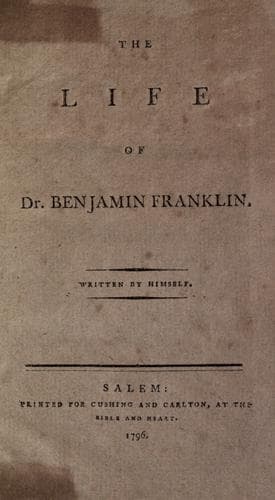
The Autobiography of Benjamin FranklinFranklin, Benjamin
ReligionComparative
The Autobiography of Benjamin Franklin
Franklin, Benjamin
Franklin, Benjamin, 1706-1790; Statesmen -- United States -- Biography
"I at present think that whoever attempts this aright, and is well
qualified, can not fail of pleasing God, and of meeting with success.
B. F."
Revolving this project in my mind, as to be undertaken hereafter, when
my circumstances should afford me the necessary leisure, I put down
from time to time, on pieces of paper, such thoughts as occurr'd to me
respecting it. Most of these are lost; but I find one purporting to be
the substance of an intended creed, containing, as I thought, the
essentials of every known religion, and being free of every thing that
might shock the professors of any religion. It is express'd in these
words, viz.:
"That there is one God, who made all things.
"That he governs the world by his providence.
"That he ought to be worshiped by adoration, prayer, and thanksgiving.
"But that the most acceptable service of God is doing good to man.
"That the soul is immortal.
"And that God will certainly reward virtue and punish vice either here
or hereafter."[9]
[9] In the Middle Ages, Franklin, if such a phenomenon as
Franklin were possible in the Middle Ages, would
probably have been the founder of a monastic order.—B.
My ideas at that time were, that the sect should be begun and spread at
first among young and single men only; that each person to be initiated
should not only declare his assent to such creed, but should have
exercised himself with the thirteen weeks' examination and practice of
the virtues, as in the before-mention'd model; that the existence of
such a society should be kept a secret, till it was become
considerable, to prevent solicitations for the admission of improper
persons, but that the members should each of them search among his
acquaintance for ingenuous, well-disposed youths, to whom, with prudent
caution, the scheme should be gradually communicated; that the members
should engage to afford their advice, assistance, and support to each
other in promoting one another's interests, business, and advancement
in life; that, for distinction, we should be call'd The Society of the
Free and Easy: free, as being, by the general practice and habit of
the virtues, free from the dominion of vice; and particularly by the
practice of industry and frugality, free from debt, which exposes a man
to confinement, and a species of slavery to his creditors.
Public-domain text, read in full here on John Shaqi.
Reviews
Reviews
No reviews yet
Be the first to share your thoughts on this work.
Elsewhere in the archive
Join the Discussion
Join the discussion
Sign in to leave a comment or review.
Sign InorCreate an account