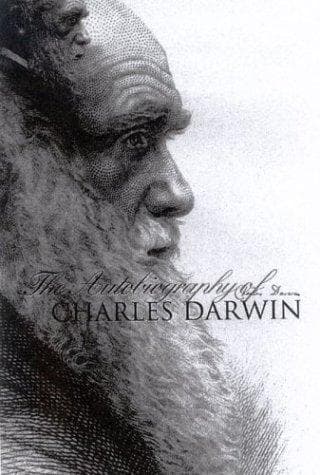
The Autobiography of Charles DarwinDarwin, Charles
Science
The Autobiography of Charles Darwin
Darwin, Charles
Darwin, Charles, 1809-1882; Darwin, Charles, 1809-1882. On the origin of species; Naturalists -- Great Britain -- Biography
During the early part of our life in London, I was strong enough to go
into general society, and saw a good deal of several scientific men,
and other more or less distinguished men. I will give my impressions
with respect to some of them, though I have little to say worth saying.
I saw more of Lyell than of any other man, both before and after my
marriage. His mind was characterised, as it appeared to me, by
clearness, caution, sound judgment, and a good deal of originality.
When I made any remark to him on Geology, he never rested until he saw
the whole case clearly, and often made me see it more clearly than I
had done before. He would advance all possible objections to my
suggestion, and even after these were exhausted would long remain
dubious. A second characteristic was his hearty sympathy with the work
of other scientific men. (The slight repetition here observable is
accounted for by the notes on Lyell, etc., having been added in April,
1881, a few years after the rest of the ‘Recollections’ were written.)
On my return from the voyage of the “Beagle”, I explained to him my
views on coral-reefs, which differed from his, and I was greatly
surprised and encouraged by the vivid interest which he showed. His
delight in science was ardent, and he felt the keenest interest in the
future progress of mankind. He was very kind-hearted, and thoroughly
liberal in his religious beliefs, or rather disbeliefs; but he was a
strong theist. His candour was highly remarkable. He exhibited this by
becoming a convert to the Descent theory, though he had gained much
fame by opposing Lamarck’s views, and this after he had grown old. He
reminded me that I had many years before said to him, when discussing
the opposition of the old school of geologists to his new views, “What
a good thing it would be if every scientific man was to die when sixty
years old, as afterwards he would be sure to oppose all new doctrines.”
But he hoped that now he might be allowed to live.
The science of Geology is enormously indebted to Lyell—more so, as I
believe, than to any other man who ever lived. When [I was] starting on
the voyage of the “Beagle”, the sagacious Henslow, who, like all other
geologists, believed at that time in successive cataclysms, advised me
to get and study the first volume of the ‘Principles,’ which had then
just been published, but on no account to accept the views therein
advocated. How differently would anyone now speak of the ‘Principles’!
I am proud to remember that the first place, namely, St. Jago, in the
Cape de Verde archipelago, in which I geologised, convinced me of the
infinite superiority of Lyell’s views over those advocated in any other
work known to me.
Public-domain text, read in full here on John Shaqi.
Reviews
Reviews
No reviews yet
Be the first to share your thoughts on this work.
Join the Discussion
Join the discussion
Sign in to leave a comment or review.
Sign InorCreate an account