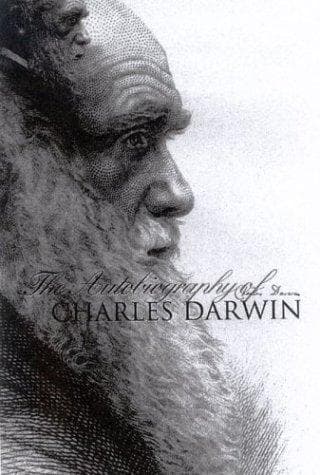
The Autobiography of Charles DarwinDarwin, Charles
Science
The Autobiography of Charles Darwin
Darwin, Charles
Darwin, Charles, 1809-1882; Darwin, Charles, 1809-1882. On the origin of species; Naturalists -- Great Britain -- Biography
My brother stayed only one year at the University, so that during the
second year I was left to my own resources; and this was an advantage,
for I became well acquainted with several young men fond of natural
science. One of these was Ainsworth, who afterwards published his
travels in Assyria; he was a Wernerian geologist, and knew a little
about many subjects. Dr. Coldstream was a very different young man,
prim, formal, highly religious, and most kind-hearted; he afterwards
published some good zoological articles. A third young man was Hardie,
who would, I think, have made a good botanist, but died early in India.
Lastly, Dr. Grant, my senior by several years, but how I became
acquainted with him I cannot remember; he published some first-rate
zoological papers, but after coming to London as Professor in
University College, he did nothing more in science, a fact which has
always been inexplicable to me. I knew him well; he was dry and formal
in manner, with much enthusiasm beneath this outer crust. He one day,
when we were walking together, burst forth in high admiration of
Lamarck and his views on evolution. I listened in silent astonishment,
and as far as I can judge without any effect on my mind. I had
previously read the ‘Zoonomia’ of my grandfather, in which similar
views are maintained, but without producing any effect on me.
Nevertheless it is probable that the hearing rather early in life such
views maintained and praised may have favoured my upholding them under
a different form in my ‘Origin of Species.’ At this time I admired
greatly the ‘Zoonomia;’ but on reading it a second time after an
interval of ten or fifteen years, I was much disappointed; the
proportion of speculation being so large to the facts given.
Drs. Grant and Coldstream attended much to marine Zoology, and I often
accompanied the former to collect animals in the tidal pools, which I
dissected as well as I could. I also became friends with some of the
Newhaven fishermen, and sometimes accompanied them when they trawled
for oysters, and thus got many specimens. But from not having had any
regular practice in dissection, and from possessing only a wretched
microscope, my attempts were very poor. Nevertheless I made one
interesting little discovery, and read, about the beginning of the year
1826, a short paper on the subject before the Plinian Society. This was
that the so-called ova of Flustra had the power of independent movement
by means of cilia, and were in fact larvae. In another short paper I
showed that the little globular bodies which had been supposed to be
the young state of Fucus loreus were the egg-cases of the wormlike
Pontobdella muricata.
Public-domain text, read in full here on John Shaqi.
Reviews
Reviews
No reviews yet
Be the first to share your thoughts on this work.
Join the Discussion
Join the discussion
Sign in to leave a comment or review.
Sign InorCreate an account