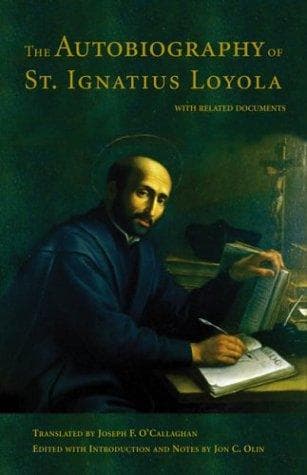
The Autobiography of St. IgnatiusIgnatius, of Loyola, Saint
Religion
The Autobiography of St. Ignatius
Ignatius, of Loyola, Saint
Christian saints -- Spain -- Biography; Ignatius, of Loyola, Saint, 1491-1556
On the third day a notary came to conduct them to prison. They were
not put with the common criminals, but their place of confinement was
nevertheless very repulsive. In the centre of the cell there was a
pillar to which was attached a chain but a few feet in length, and so
riveted to the prisoners that when either moved the other was obliged
to follow him. They passed that night without any sleep. On the
following day, however, the report spread that they were prisoners.
The people then hastened to supply them with all they needed.
Ignatius, as may readily be supposed, lost no opportunity of speaking
upon spiritual things with those who came to see them.
They were each separately examined by a friar, to whom Ignatius
delivered all his writings. Among these were his Spiritual Exercises,
that it might be seen whether or not they contained any false
doctrine. When asked about his other companions, he told who and where
they were. They were arrested also, and confined in separate
apartments from that in which Ignatius was placed.
Although help was offered on this occasion, he declined to accept it.
After a few days he was called into the presence of the judges and
professors, who made him answer many questions, not only on his
Spiritual Exercises, but even on articles of faith, as, for example,
the Trinity and the Blessed Sacrament, requiring him to explain these
mysteries.
So clear and exact was his explanation that his examiners could not
find the least flaw in his doctrine. He was equally correct in the
answer to the friar who proposed a difficulty in Canon Law.
In every case he said that he did not know the decision of the
professors.
When ordered to speak on the first commandment, he gave so full and
exhaustive an explanation as to leave to his hearers no further chance
of questioning him.
Although he had not completed his studies, he frequently showed the
difference between a mortal and a venial sin of thought. While
speaking about his Exercises, he was closely questioned. To their
questions, however, he replied, "What I say is either false or true;
if false, condemn it." The doctrine remained uncondemned.
Francis de Mendoza, afterward Cardinal of Valencia, was one of those
who came to the prison to visit Ignatius. One day, while accompanied
with the friar, he asked him whether the prison and chains were not
insupportable. "I shall give," said Ignatius, "the reply made to-day
to a woman who bewailed my lot. For the love of Jesus Christ, I gladly
would wear all the handcuffs and chains that could be found in
Salamanca. And if you consider this an evil, you show that as yet you
are not desirous of suffering imprisonment for the love of Our Lord."
About this time it happened that all the inmates of the prison
managed to escape, leaving only Ignatius and his companions. When this
became known it caused a reaction in their favor, and they were placed
for the time in a large building adjoining the prison.
Public-domain text, read in full here on John Shaqi.
Reviews
Reviews
No reviews yet
Be the first to share your thoughts on this work.
Join the Discussion
Join the discussion
Sign in to leave a comment or review.
Sign InorCreate an account