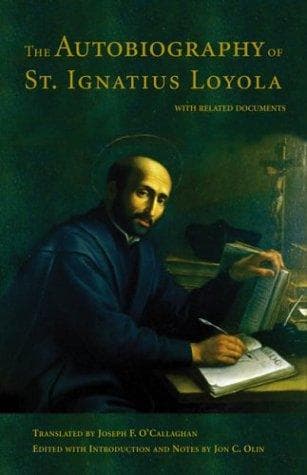
The Autobiography of St. IgnatiusIgnatius, of Loyola, Saint
Religion
The Autobiography of St. Ignatius
Ignatius, of Loyola, Saint
Christian saints -- Spain -- Biography; Ignatius, of Loyola, Saint, 1491-1556
In the meantime his strength was failing. He could take no food, and
showed other symptoms of approaching death. On the feast of St. John
the doctors gave up hope of his recovery, and he was advised to make
his confession. Having received the sacraments on the eve of the
feasts of Sts. Peter and Paul, toward evening the doctors said that if
by the middle of the night there were no change for the better, he
would surely die. He had great devotion to St. Peter, and it so
happened by the goodness of God that in the middle of the night he
began to grow better.
His recovery was so rapid that in a few days he was out of danger. As
the bones of his leg settled and pressed upon each other, one bone
protruded below the knee. The result was that one leg was shorter than
the other, and the bone causing a lump there, made the leg seem quite
deformed. As he could not bear this, since he intended to live a life
at court, he asked the doctors whether the bone could be cut away.
They replied that it could, but it would cause him more suffering than
all that had preceded, as everything was healed, and they would need
space in order to cut it. He determined, however, to undergo this
torture.
His elder brother looked on with astonishment and admiration. He said
he could never have had the fortitude to suffer the pain which the
sick man bore with his usual patience. When the flesh and the bone
that protruded were cut away, means were taken to prevent the leg from
becoming shorter than the other. For this purpose, in spite of sharp
and constant pain, the leg was kept stretched for many days. Finally
the Lord gave him health. He came out of the danger safe and strong
with the exception that he could not easily stand on his leg, but was
forced to lie in bed.
As Ignatius had a love for fiction, when he found himself out of
danger he asked for some romances to pass away the time. In that
house there was no book of the kind. They gave him, instead, "The Life
of Christ," by Rudolph, the Carthusian, and another book called the
"Flowers of the Saints," both in Spanish. By frequent reading of these
books he began to get some love for spiritual things. This reading led
his mind to meditate on holy things, yet sometimes it wandered to
thoughts which he had been accustomed to dwell upon before.
Public-domain text, read in full here on John Shaqi.
Reviews
Reviews
No reviews yet
Be the first to share your thoughts on this work.
Join the Discussion
Join the discussion
Sign in to leave a comment or review.
Sign InorCreate an account